


Jiří wrote it on a Tuesday afternoon in a café I always love to visit, because they have decent coffee and Wi-Fi that drops every 11 minutes. So this will teach you patience and make you slow down, while their coffee helps you forget all about the Wi-Fi problems.
I was at the next table for about two hours, pretending to work on my new book I had been avoiding since March. He had a laptop, a paper notebook, and a cortado he let go completely cold. At some point a woman came in with an enormous dog and half the room had to move their bags.
He wrote maybe nine hundred words that afternoon and read the middle section out loud to me twice because he wasn’t sure it worked. It didn’t work the first time.
Three weeks later, a different friend sent me the published version of this article with one line attached: “Shame he used AI for this.”
I told him I watched the guy write it. Notebook, cold coffee, dog, all of it.
He said, “Well. It reads like AI.”
That’s the whole thing, right there. Not “I checked.” Not “here’s my evidence.” Just a feeling that arrived first and looked for a reason afterward.
When somebody says AI wrote this, most of the time they’re saying something much smaller and much older. They didn’t like it. It was too smooth, or too tidy, or it used a word they’ve decided is contaminated. “AI wrote it” has quietly become the most socially acceptable way to say “this bored me and I want that to be your fault.”
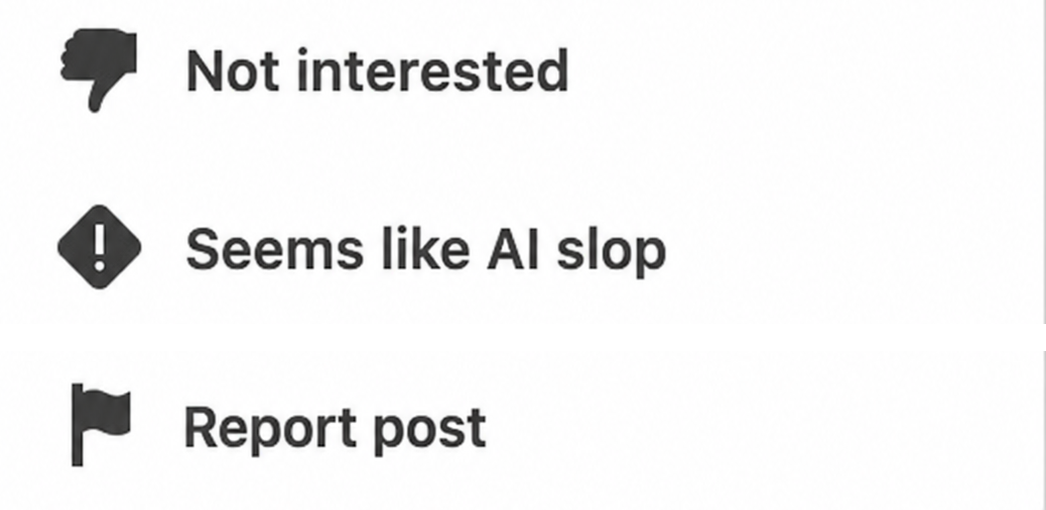
Which brings me to the new LinkedIn button “Seems like AI slop”.
The coffee shop test
LinkedIn now lets you click the three dots on any post and select “Seems like AI slop.” And the person who wrote it gets told, privately, in their analytics.
Plenty of people are celebrating. I understand why. The feed is genuinely bad, and it has been bad for a while (read years), and doing nothing was not a great option either.
But look at what the button actually is. It’s “Not Interested” with anger in it. Same click, same outcome for you, more feeling attached. And that matters, because the thing LinkedIn says it wants to collect is a signal about how a post was produced, while the thing users will actually give them is a signal about how a post landed. Those are different types of data. Mixing them up and calling it a training set is a choice with consequences.
LinkedIn’s own product chief said the quiet part clearly enough: slop is hard to define, the definition keeps moving, and the button is there to tune their models. Read that again. They’re not claiming users can identify machine-written text. They’re collecting a taste signal and using it to train something, which is a defensible product decision and a terrible public framing, because the label on the button says “AI slop” and the thing it measures is closer to “ugh.”
The detection question is the part almost nobody is testing before they get excited. Can people tell? Really tell, when you take away the tells they think they’re using?
Nobody has ever been good at this
4,600 participants. Six experiments. Professional profiles, hospitality profiles, dating profiles. People could not distinguish AI-written self-presentations from human-written ones at a rate better than chance, and paying them for accuracy didn’t fix it. The researchers found that human judgment was being driven by heuristics that sound reasonable and aren’t: first-person pronouns, contractions, mentions of family, a certain kind of casualness. AI systems can produce all of those on request. So the heuristics don’t just fail, they point in a direction that can be gamed on purpose.
And this was three years ago, with models that would embarrass you today.
There’s older evidence in a stranger place. Köbis and Mossink ran an experiment with poetry, comparing human-written poems with machine-written ones, and readers couldn’t reliably separate them either. Poetry. The most human-coded form of writing there is, the thing we supposedly feel in our chest. That study is from around 2021 and I’ve only read the summary and the abstract, not the full method, so treat my description of it as approximate.
The obvious response is that people just need practice. Show them examples, tell them what to look for, and accuracy goes up. That idea has been tested. A team at the University of Washington and the Allen Institute had evaluators judge machine-written text against human-written text and found them sitting at about 50 percent, and the training they tried afterwards moved the needle by a few points at best. That paper is from 2021, so the models in it are ancient, and the direction of travel since then has not been favourable to human judges.
I ran my own version of this by accident. Across 1,072 sessions of resume review, I tracked how often experienced recruiters correctly identified a CV as AI-written.
It came out close to a coin flip. Not because the recruiters were careless. Because the thing they were looking for (polish, symmetry, a certain rhythm in bullet points) is also what a good career coach produces, and what a template produces, and what a nervous candidate who rewrote the same sentence eleven times produces.
Now put Pangram’s number next to that. Their browser extension flags roughly two thirds of LinkedIn posts as AI-generated, with more than 40 percent of long-form posts coming back as fully AI-generated. That number got a lot of attention this week as evidence of a crisis.
I think 40 percent is low. Not because these detectors are bad (I think they are not working at all), but because the posts they catch are the ones where nobody bothered. Paste the output, hit publish, move on. Everyone I know in content is using these tools. The difference between the flagged 40 percent and the unflagged rest is not usage; it’s care. Some people run three passes, strip the vocabulary, break the rhythm, add a real detail from a real Tuesday. The tool was involved in both. Only one gets caught.
Detection tools measure carelessness. We keep reading them as if they measure honesty.
Who adapts in fifteen seconds
Think about the account posting forty times a week. Growth account, ghostwritten, running on volume.
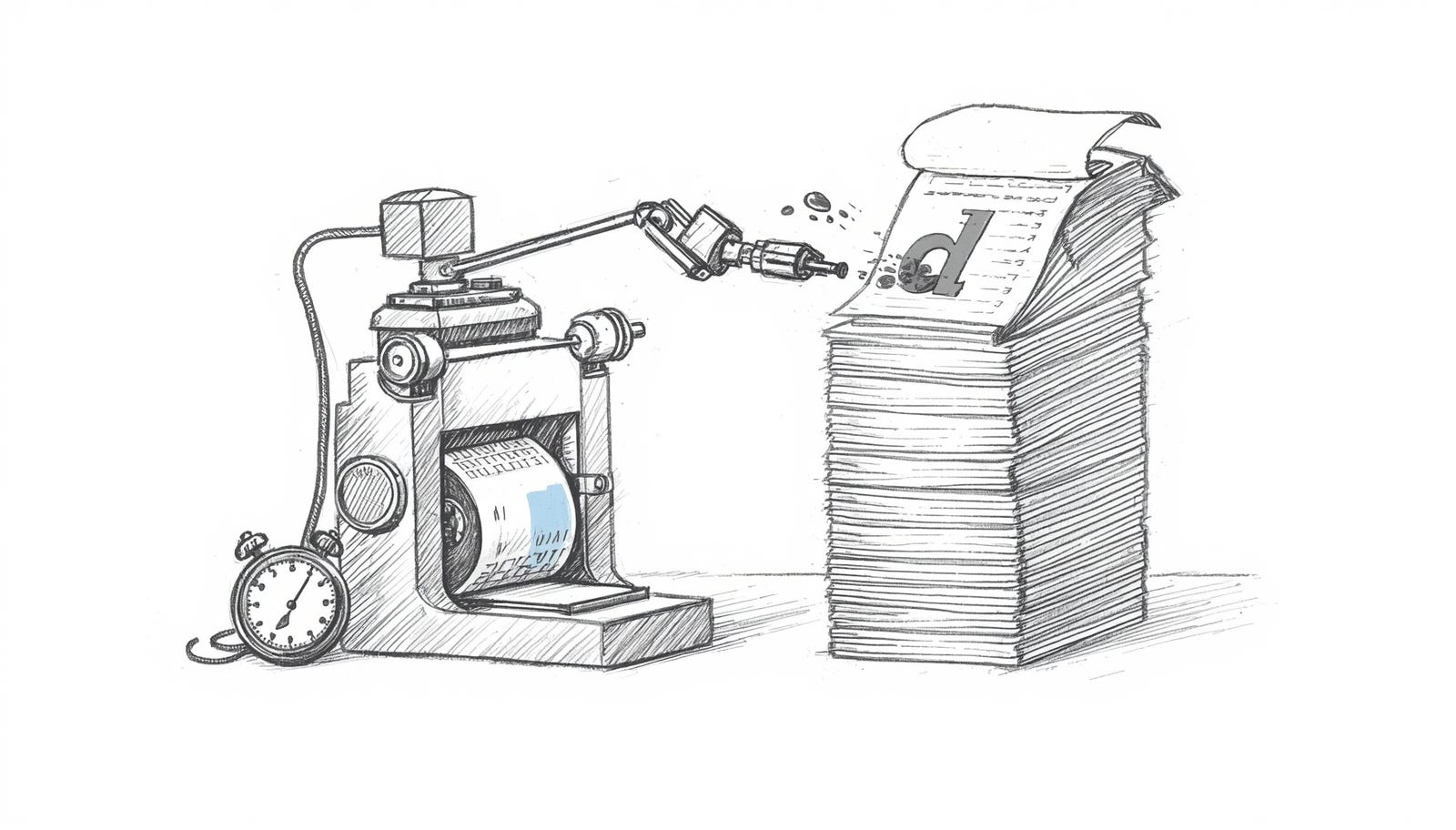
That operator adds one line to a prompt. No em dashes. Never use the word delve. Leave one typo in. Vary the sentence lengths. Fifteen seconds of work, maybe thirty if they’re thorough, and the output stops matching the pattern people report.
What’s left to flag is the writer who never learned to fake being sloppy. The person who has written the same way for eleven years, who happens to like colons, who edits carefully because that’s how they were trained. They get reported for punctuation and told it’s a quality signal.
I keep thinking about a Czech friend of mine who works in recruitment and writes in English, and her English is formal in the way that second-language English often is. Very correct. Slightly stiff. No contractions, because contractions were the last thing she learned and she still doesn’t fully trust them. Her writing pattern-matches to machine output almost perfectly, and there is nothing she can do about it short of writing worse on purpose. What does the private notification in her analytics do to her? I don’t know. I genuinely don’t. I’d like to see LinkedIn publish something about who gets flagged, broken out by whether English is the poster’s first language, and I doubt they will.
Meanwhile the actual volume sits somewhere else entirely. LinkedIn says it’s blocking hundreds of thousands of automated comment attempts a day, plus millions of other automation attempts in recent months. That’s their own number, from their own chief product officer, announced in the same breath as the button. Machines catching machines. No human vote required, no punctuation on trial. That part I have no argument with. That’s the part that will actually change the feed.
And then there’s the tab sitting right next to all of this. LinkedIn is still putting AI into InMail. I get dozens of these a week and they open identically. “Jan, I’m impressed by your extensive experience in recruitment.” Written by the platform’s own tooling, delivered to my inbox, and there is no slop button in the inbox. They’ve retired the “enhance your post” feature and are replacing it with a proofreader, which is a real concession and I’ll give them credit for it. The messaging side hasn’t moved.
One team is fighting slop. Another team is shipping it. This is what large companies look like from the inside and I don’t think it’s hypocrisy exactly, but it does tell you how seriously to take the framing.
Punctuation is not evidence
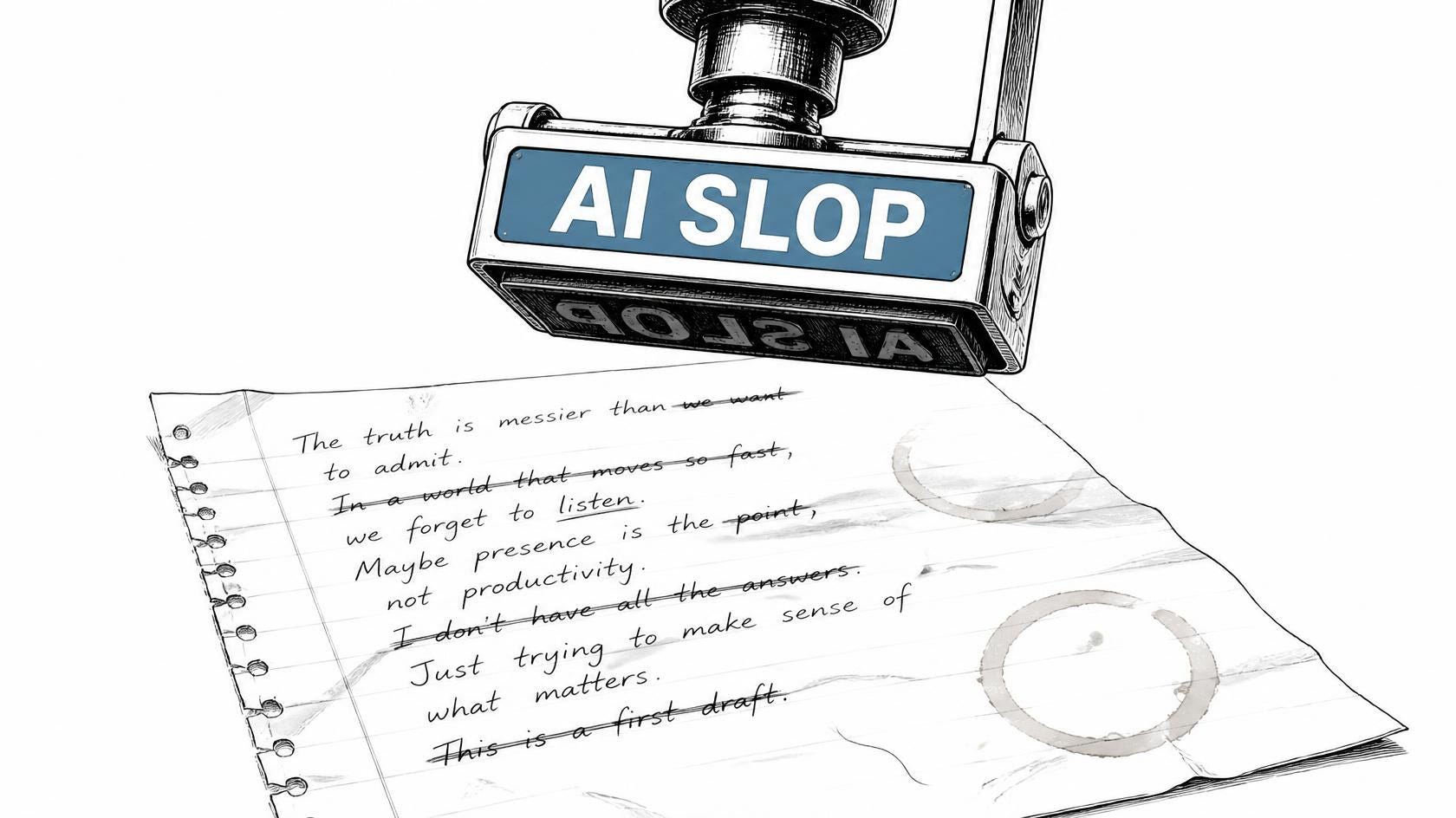
So take away the em dash. Take away delve, tapestry, “in today’s fast-paced world,” the tricolon, the neat closing line. Assume the writer has scrubbed all of it, because the ones producing volume already have.
What’s actually left that tells you a machine wrote it?
Here’s what I’ve got, and it’s less than I’d like. Specificity that couldn’t be guessed. Not “a recent conversation with a candidate” but the fee percentage, the city, the thing the candidate said that made the room awkward. Claims that could be wrong and that would cost something if they were. A position the writer would have to defend at a conference.
That’s roughly it.
And every one of them can be produced on request. You can prompt for irrelevant detail. You can prompt for a stated position. The output is often good. So what I’m describing isn’t a detection method, it’s a description of what makes writing worth reading, which is a different question that we have collectively confused with the first one for about three years now.
Something I noticed is that the em dash panic is regional. My English-speaking friends treat it as the mark of the machine. Nobody writing in Czech cares, partly because we punctuate differently and partly because the models produce noticeably worse Czech, so the tells are actual errors rather than stylistic tics. Whatever detection instinct people think they have, it’s built on one language and about eighteen months of exposure to one family of models. That seems fragile. I don’t know what to do with the observation, but it’s been sitting with me.
The cost of caring about this is real, by the way. If you decide to write in a way that survives the test, you write slower. Much slower. I spend somewhere between four and six hours on a newsletter piece, and most of that is not writing; it’s throwing away the version that came out smooth. I’ve missed self-imposed deadlines over it. Two weeks ago I published in another newsletter something I knew was flat because the alternative was publishing nothing, and it did fine, which was its own small insult.
There’s a whole separate argument about whether people should be required to disclose AI use, and I’m not getting into it here. I have opinions. They’re not settled enough to be worth 400 words.
A million noisy votes
Sometimes people are right. Sometimes you look at a post and think “machine” and it was, in fact, generated in nine seconds by someone who didn’t read it before posting. Aggregate a million of those judgments and you might get a usable signal even if each individual judgment is noise. That’s not nothing. Crowd systems work that way sometimes.
But the crowd will be voting on a moving target, against people who can adjust their output faster than the crowd can adjust its instincts. And the feedback loop runs in one direction. The volume accounts get told which patterns to drop. The careful writers get told they seem fake.
What I’ll be watching for over the next few months is whether the classifiers they’re building end up doing the real work while the button just gives people somewhere to put their irritation. That would be fine, honestly. Not the worst outcome. It would be a pressure valve that makes users feel heard while the machine-versus-machine fight happens somewhere they can’t see.
I don’t think that’s the version we’ll get, but I’ve been wrong about LinkedIn product decisions before, most recently about whether they’d ever kill the enhance button.
My friend never did apologise about the article, by the way. He read a second one a month later and said that one was fine.
Articles you should check:


