


In 2016, Geoffrey Hinton stood in front of a room and said medical schools should stop training radiologists. “It’s just completely obvious that within five years, deep learning is going to do better than radiologists.” He compared the profession to a coyote that had already run off the cliff but hadn’t looked down yet.
Medical students listened. Some of them changed specialties. A radiology resident named Arjun Byju later wrote that he personally knew people who picked different careers because of that one quote.
Ten years later, the Mayo Clinic employs over 400 radiologists. That’s a 55% increase since Hinton spoke. Average radiologist pay in the US has climbed to roughly $571,000. There were more than 4,000 open radiologist positions in early 2025, taking around 130 days to fill. A University of Virginia economist who studies physician labor markets put it plainly: the exact opposite of the prediction happened.
Hinton eventually walked it back. He clarified he only meant image analysis, not the whole job. Fine. But the students who switched careers in 2017 don’t get those years back.
And you know what happened to Hinton’s credibility as a forecaster? Nothing. He won a Nobel Prize. His new predictions about AI and jobs get quoted in every major outlet, every week, with the same certainty as the radiology one.
That’s not a story about Hinton. That’s a story about us.
We keep score in every field except this one
If your weather app told you sunshine and you got soaked three Fridays in a row, you’d switch apps. If a stock picker lost you money five years straight, you’d fire him. If a recruiter told you “this candidate will definitely accept” and the candidate ghosted four times in a row, you’d stop trusting that recruiter’s read.
Job market predictions are the one forecast category where the track record never gets pulled up. A new report drops, the headline number is terrifying, LinkedIn catches fire for a week, and the anxiety settles into people’s career decisions. Then the deadline year quietly arrives, the prediction quietly fails, and the same firm publishes a new number with a new deadline. Nobody puts the old chart next to the new one.
I want to put the old chart next to the new one.
In January 2016, the World Economic Forum published its Future of Jobs report and predicted a net loss of more than 5.1 million jobs to automation and disruption between 2015 and 2020, with white-collar office and administrative roles hit hardest. That press release is still on their website. You can read it today.
What actually happened by the end of 2019? The US hit a 50-year low in unemployment. Europe hit record employment levels. The administrative apocalypse did not arrive. The job losses that finally showed up in 2020 came from a virus, not from robots.
Did anyone at Davos in 2021 open with “our 2016 forecast missed by roughly five million jobs, here’s what we got wrong”? They did not. They published a new report with new numbers. In 2020 the WEF predicted the “robot revolution” would displace 85 million jobs by 2025 but create 97 million new ones. Nobody has validated the 97 million. Nobody is tracking it. The 2025 edition simply changed the framing.
Gartner is my favorite example, because Gartner contradicted itself in writing, on its own website, and both pages are still live.
In December 2017, a Gartner press release stated that AI would become a net job creator starting in 2020. It will create 2.3 million jobs while eliminating 1.8 million, reaching two million net-new jobs by 2025. Their head of research said it on stage at their own symposium.
In May 2026, a Gartner press release stated that AI would create more jobs than it eliminated beginning in 2028. Same company. Same confident tone. The goalpost moved back by eight years, and the release doesn’t mention that the 2017 version exists.
And it wasn’t the first flip. Back in 2014, Gartner’s head of research Peter Sondergaard told his symposium audience that one in three jobs would be converted to software, robots and smart machines by 2025. One in three. That’s tens of millions of jobs in the US alone.
2025 came and went with nothing remotely close, and the person who told me about that quote wasn’t a journalist or a researcher. It was a warehouse automation salesman, at a conference dinner, using it as a joke about his own industry. The forecast had degraded from strategy input to punchline in one decade, and Gartner’s brand didn’t lose a millimeter.
I’m not saying Gartner analysts are incompetent. They’re not. I’ve used Gartner research in my life a lot, and some of it is genuinely useful for what it’s designed for, which is helping enterprises decide what software to buy. I’m saying that forecasting labor markets a decade out is close to impossible, the firms doing it face no penalty for missing, and we keep treating each new number as if the last number never happened.
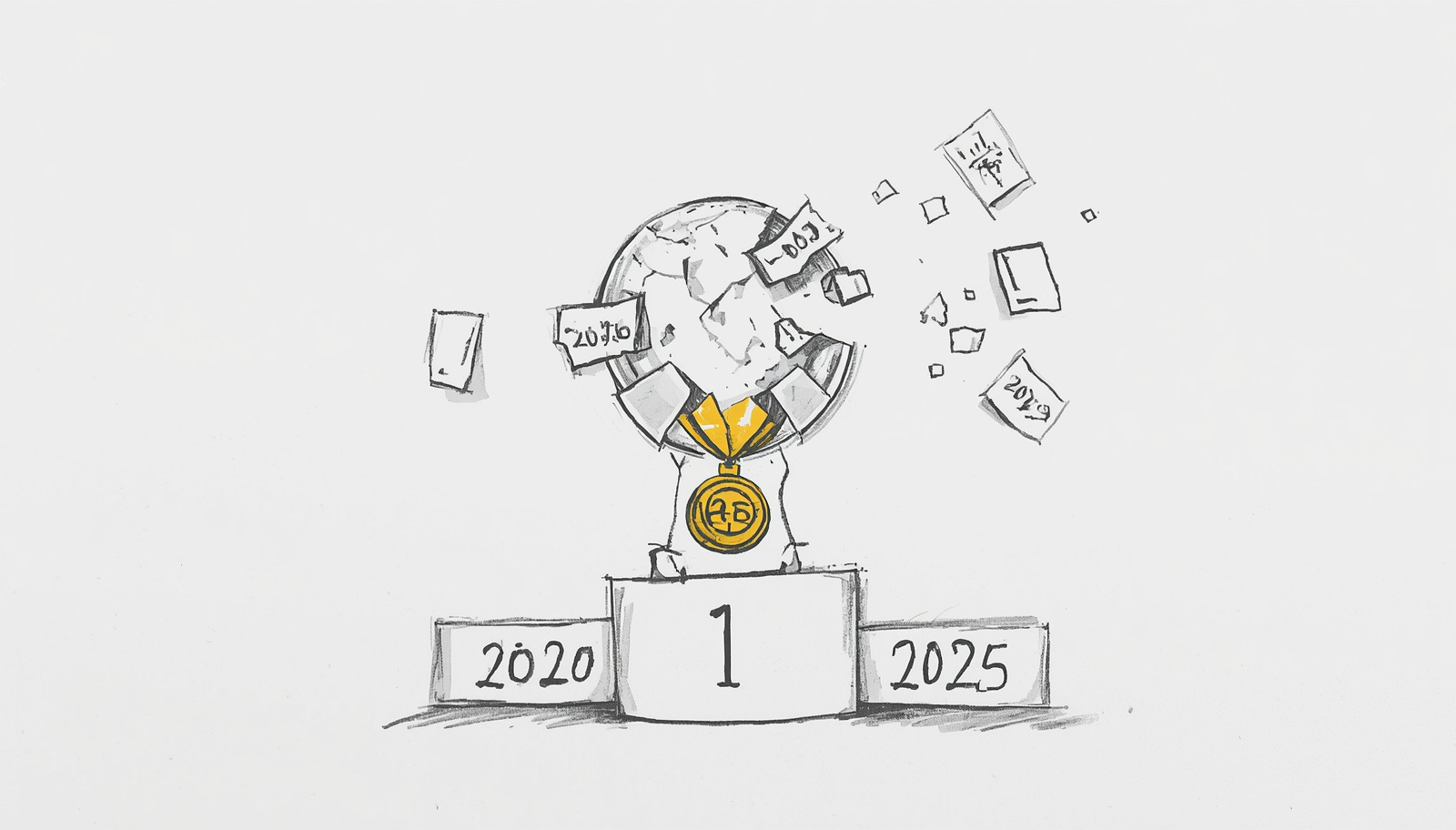
Why the misses never register
Two pieces of research explain this issue better than I can.
The first is Philip Tetlock’s work at Berkeley and Penn. Over about 20 years he collected roughly 28,000 predictions from 284 experts in politics and economics, then waited to see what came true. The average expert’s predictions were about as accurate as random guesses. Tetlock’s famous line was that the average expert was roughly as accurate as a dart-throwing chimpanzee. The finding that should worry you more: the most famous experts, the ones journalists quote most, were among the least accurate. Confidence and media presence predicted attention. They did not predict accuracy.
The second is older and stranger. In the 1950s, Leon Festinger infiltrated a small cult in Chicago whose leader had predicted the world would end on a specific date. Festinger wanted to know what happens to believers when a prophecy fails on schedule. The end of the world came and went. The believers did not quit. Most of them believed harder, and started recruiting, something they hadn’t done before. Festinger wrote it up in a book called When Prophecy Fails, and it became the founding case study of cognitive dissonance.
A cult is an extreme case, and I’m not calling anyone who shares a Gartner chart a cult member. But the mechanism travels. When a prediction we’ve emotionally invested in fails, the comfortable move isn’t to update. It’s to reach for the next prediction that restores the feeling of knowing what’s coming. Fear of the 2020 automation wave rolls straight into fear of the 2027 agent wave without ever passing through “the 2020 wave didn’t happen.”
There’s also a boring structural reason. Scary forecasts are a product. “32 million jobs transformed per year” sells reports, conference tickets, and consulting engagements. “We genuinely don’t know, and our last three forecasts missed” sells nothing. I don’t think most analysts are cynical about this. I think the incentive works on them the way water works on stone, slowly and without anyone deciding anything.
The anxiety itself has a price tag
You might think the worst case for a wrong forecast is a wasted worry. It’s not. The worry does damage while it waits to be disproven.
Gartner, of all sources, measured this. Their Global Labor Market Survey from early 2026 covered 12,004 employees and managers across 40 countries, and one finding jumped out at me: employees with a positive outlook toward AI are 3.4 times more likely to be highly productive. The same research says widespread anxiety about AI-driven job loss is undermining productivity and slowing adoption across the workforce. So the firm whose scary numbers feed the anxiety is also the firm documenting that the anxiety wrecks performance. I read both releases in the same sitting and honestly couldn’t decide whether to laugh.
Sit with the loop for a second. A forecast predicts your job will disappear. You believe it. Your engagement drops, you stop investing in skills for a role you think is dying, your output slips. Your manager notices. When cuts come for ordinary budget reasons, you’re nearer the top of the list. The prediction didn’t come true. You made it true, partially, at the individual level, and the forecaster will count you as a data point proving they were right.
What this does to actual people
In March I had a coffee with a sourcer I’ll call Marek. We were supposed to talk about his CV. It was one of those Prague mornings when the tram windows were fogged up, and the café got my order wrong (for the second time at that place). I remember being half-distracted because I’d left my laptop charger in my hotel room and my battery was at 11%.
Marek didn’t want to talk about his CV. He wanted to tell me he was leaving recruiting entirely, retraining as an electrician, because he’d read that AI agents would replace most sourcing work by 2027. He’d already paid the deposit for the course, and his father, who is an electrician, will teach him the craft as well.
Nothing wrong with becoming an electrician. Good trade, real shortage, honest work. What bothered me was the reasoning. He couldn’t tell me who made the 2027 prediction. He couldn’t tell me their previous prediction or whether it came true. He was making a five-figure, multi-year life decision based on a number he’d absorbed from a headline, produced by a source he couldn’t name, with a track record he’d never seen.
I should complicate this story, because it’s not clean. Sourcing really is changing, faster than most recruiting work. Some of Marek’s anxiety was earned, and if he hates the ambiguity enough that a trade feels better, the move might be right for him for reasons that have nothing to do with the forecast. I’ve also met people who ignored every warning about their industry and got flattened. Dismissing all predictions is just the same laziness pointed in the other direction.
But look at what the prediction economy did to him. It didn’t inform a decision. It replaced the decision. The forecast arrived with so much borrowed authority that checking it never occurred to him.
And the checking is not hard. It took me about forty minutes to find everything in this article. The WEF press releases are public. The Gartner press releases are public. The Forrester forecasts are public. These firms leave their misses lying around in plain sight because they know almost nobody will look.

The asymmetry that should make you angry
Think about who paid for these misses.
The medical students who avoided radiology paid. The specialty now has its largest shortage in history, partly because the doom coverage of the late 2010s thinned the pipeline, which means patients wait longer for scan results. Real people, real backlogs, measured in months at some centers.
Marek paid a deposit.
The forecasters paid nothing. Not one analyst lost a job over the 2016 or 2017 numbers. The firms’ revenues grew. The next report got the same breathless coverage as the last one.
That asymmetry is the whole game. Predictions transfer anxiety downward and accountability nowhere. The people with the least power to absorb a wrong forecast (students, junior workers, career changers) are the ones who act on it, while the people producing it face a risk profile of approximately zero.
The current cycle is running the same script with bigger numbers. Gartner now says 32 million jobs will be significantly transformed by AI every year in the near term. Maybe. I genuinely don’t know, and neither do they, and “transformed” is doing so much work in that sentence that the claim can’t fail no matter what happens. Every job gets transformed by something every year. Mine has been transformed four or five times since 2005 by LinkedIn, by ATS platforms, by remote work, by sourcing tools, and nobody issued a press release about any of it.
Notice what the word choice buys them. “Eliminated” can be counted and checked. “Transformed” cannot. After a decade of missed elimination numbers, the industry drifted toward vocabulary that survives contact with reality. That drift is the closest thing to an admission of failure you’ll ever get from a forecasting firm, and it arrived without a single retraction.
So when someone shares the next terrifying number with you, you have two options. Absorb the anxiety, like the medical students did. Or spend forty minutes with the source’s archive first.
I don’t have a policy fix for this and I’m suspicious of anyone who claims one. What I have is a personal fix, which is smaller and less satisfying: before any forecast is allowed to change one of my decisions, it has to survive a few specific checks. The checks are mechanical. They take under an hour. They would have caught Hinton in 2016, the WEF in 2016, and Gartner in 2017, and they’re what I want to show you next.
The predictions will keep coming. The anxiety is optional.
The five checks I run before any forecast touches my decisions
I told you checking a forecast takes under an hour and would have caught the radiology prediction before anyone switched careers. This section is the actual procedure: five checks, in order, with the sources I use and one full worked example where I audit a live 2026 prediction in front of you. It’s a method, not more stories.
The five checks, in order
Run these in sequence. Most bad forecasts die at check two, so you rarely need all five.
