


You’ve thought about it. Moving somewhere new, quitting the job, cutting off the people who drain you, starting completely fresh somewhere nobody knows your name. The fantasy has a specific texture: you in a different city, different apartment, different cast of characters, and the old version of you left behind like a shed skin.
But the main problem is that the old version of you gets on the plane too.
I’ve watched this pattern long enough to have a hard opinion about it. Not from a distance. Up close, in conversations with people who’ve done the dramatic version and come out the other side genuinely confused about why they still feel the same.
The apartment is different. The commute is different. They even got the dog they always said they’d get once they had space. And yet something that felt like a permanent feature of the old life came with them, tucked into their personality somewhere they couldn’t see.
The drama is the problem
We reach for big, visible change when we’re stuck. It feels commensurate with the problem. If the situation is serious, the solution should be serious. Blowing up your life has a certain integrity to it. You’re not pretending things are fine. You’re doing something.
But the research on behavioral change is pretty stubborn about this. BJ Fogg at Stanford spent years studying what actually gets people to change, and the core finding sits uncomfortably against everything the self-help industry wants you to believe: small, specific, immediately achievable behaviors produce lasting change. Large, vague, emotionally charged goals mostly don’t. His 2019 book Tiny Habits documents this across thousands of participants in structured behavior-change programs. The failure rate for dramatic overhaul isn’t slightly worse than the small-habits approach. It’s not even close.
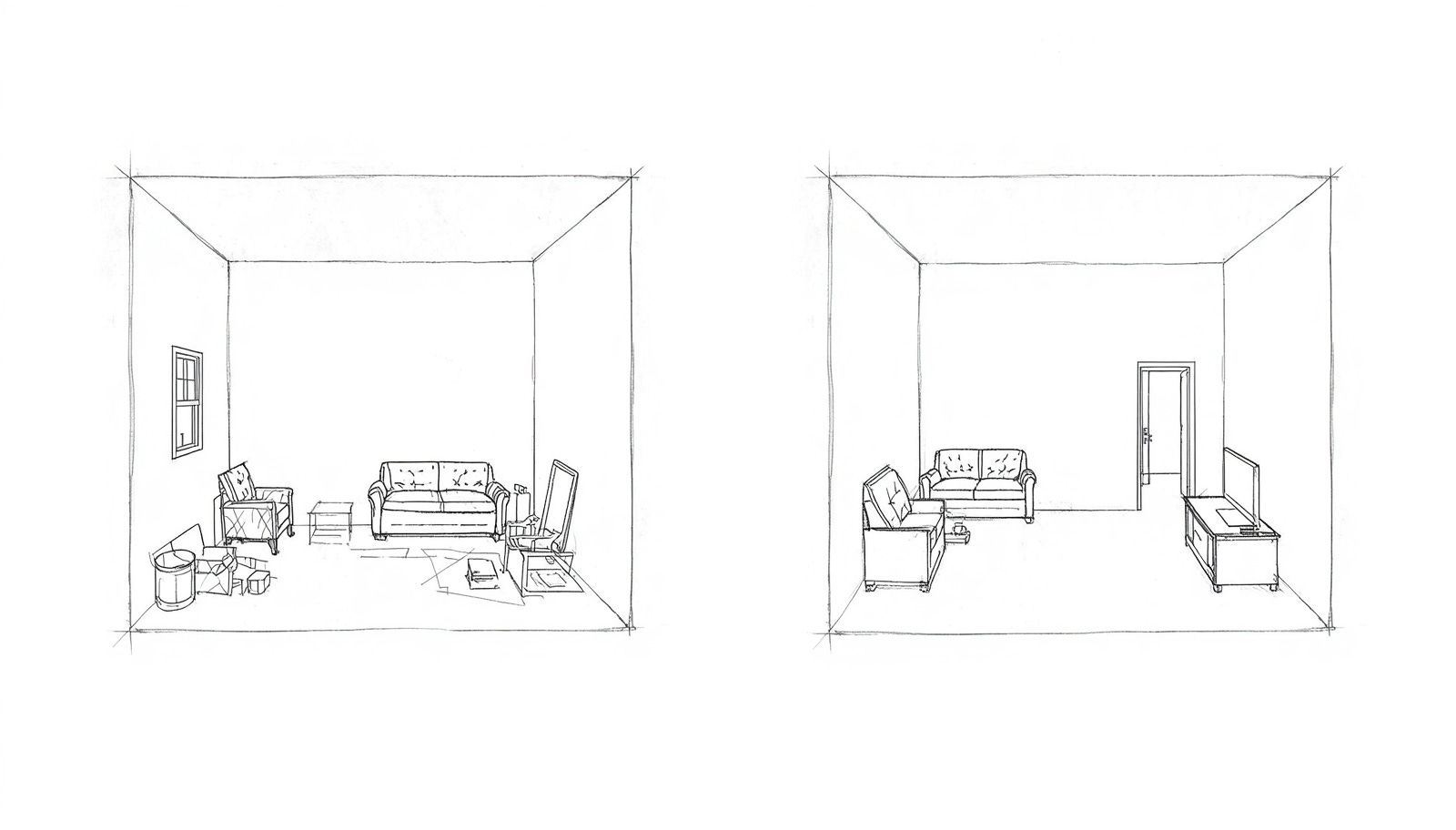
What the dramatic reset actually does is temporarily change your external inputs. That part works, for a while. New city, new sensory experience. Different job, different faces in your morning. The mood lifts. You feel like you’ve done something real. And then, because the actual machinery of how you think and respond and avoid and procrastinate and cope hasn’t shifted at all, you slowly reconstruct the same shape of life in new surroundings. Different furniture, same room.
I’ve seen it go the other way too, so I want to be precise here. Sometimes leaving a relationship or a job is the correct move and you should do it without hesitation. But those are different decisions. They’re removals of something actively harmful. That’s not the same thing as a reset. The people I’m thinking of didn’t need to remove something specific. They needed to stop feeling like themselves and hoped a new context would do that work. It rarely does, and when it does, it’s usually for reasons I’ll get to.
The fantasy of the dramatic reset is partly a symptom of the same thing you’re trying to fix. When your daily life feels unmanageable, you feel anxious, the brain starts searching for an exit, something big enough to justify the scope of the discomfort. The search for that exit can become its own distraction, a plan that relieves pressure without actually changing anything.
What your nervous system actually responds to
Your brain doesn’t primarily respond to your intentions. It responds to patterns. Patterns built from context, timing, and repetition, most of which you didn’t consciously choose.
Matthew Walker’s research on sleep, from his work at UC Berkeley and documented in Why We Sleep (2017), makes a claim that should be more disruptive than it is. Nearly every cognitive and emotional function degrades in a sleep-deprived state, and we are spectacularly bad at recognizing how impaired we actually are. Participants who slept six hours a night for two weeks performed as poorly on cognitive tests as people who had stayed awake for 24 hours straight, but they consistently rated themselves as “slightly tired” rather than severely impaired. They couldn’t feel the deficit anymore.
The implication is uncomfortable. A significant portion of what people interpret as a personality problem, a motivation problem, or a values problem is a sleep problem wearing a more interesting costume.
Someone reads about sleep deprivation and decides that everything wrong in their life is basically a rest deficit, that they’re fundamentally fine and just need more hours. Then they sleep nine hours a night for a month and still feel terrible, which tells them something different is going on. The sleep-first principle isn’t a cure for everything. It’s more like clearing static from a signal so you can actually hear what’s underneath.
Your nervous system also responds to physical environment in ways that feel slightly embarrassing to admit if you think of yourself as someone who operates on logic and will. The Broken Windows theory from the 1980s is contested and has been badly misused, but it documented something real that anyone who’s tried to work in a chaotic space intuitively knows: visible disorder in your immediate environment increases the probability of further disorder. Not through mystical connection. Through attentional load. Every piece of clutter is something your brain has to decide to ignore, and that decision, repeated hundreds of times a day, costs something even if each individual cost is tiny.
Wendy Wood’s research at USC, summarized in Good Habits, Bad Habits (2019), puts a number on how much of daily behavior is context-driven: roughly 43% of what we do each day happens in the same location, in response to environmental cues rather than deliberate choice.
You don’t decide to check your phone. You just do it, in the same chair, at the same time, because that’s what that chair at that time has come to mean. Change the context and you interrupt the cue. Not permanently. But enough to create a gap where a decision used to be automatic.
Sleep first, everything else later
The order I’d actually follow is not the order that feels emotionally satisfying, which is probably why most people don’t follow it.
Start with sleep. Not dramatically. Not with a seventeen-step sleep hygiene protocol. One change: a consistent wake time, held every day regardless of when you went to bed the night before.
The American Academy of Sleep Medicine’s research consistently shows that wake-time consistency is the single strongest behavioral lever for sleep quality, stronger than bedtime, stronger than room temperature, stronger than most supplements. The circadian rhythm anchors to morning light and wake time. Bedtime regulates itself over weeks once the anchor is set.
Do this for two weeks before you change anything else.
The reason isn’t that sleep is more important than your relationships or your work or whatever you’ve decided is the problem. The reason is that you cannot accurately assess any of those things when you’re chronically underslept. You’ll make worse decisions. You’ll interpret neutral events as threatening. You’ll have significantly less capacity to tolerate the discomfort that real change requires. Trying to fix other things while sleeping badly is like diagnosing an engine problem with the car running. Too much noise.
And I'm not going to pretend it isn't annoying that once you get a few nights of better sleep you'll feel the urge to add more things. You’ll want to wake up at 5am and cold-shower and journal and meal prep and run. That impulse is part of the same problem you’re trying to solve. It’s the dramatic-reset energy in different clothes. Don’t do it.
I’ve failed at this specific part more times than I’d like to count. Something shifts slightly and instead of holding steady I pile on, and then two weeks later I’m back where I started with a broken streak and a mild sense of personal failure as a bonus. The consistency is harder than it sounds because the consistency is boring, and boring things are easy to abandon when you don’t see immediate results.
The environment variable nobody adjusts
A friend spent eight years as a freelance writer in London and felt, by her own description, like she was circling the same five thoughts in the same flat with the same coffee and the same arguments online and she was done with it. She moved to Lisbon. I was skeptical. We’d had the conversation about how this tends to go.
It actually helped. Not entirely. Not permanently. She still avoided the hard projects and did the easier paid work first. She still procrastinated in the same specific way, everything urgent at the last minute and everything important deferred. But something in the sensory shift knocked a few things loose that had been calcified for years, and she came back to London two years later, for an unrelated reason, feeling meaningfully different from when she’d left.
I don’t think it was Lisbon specifically. I think it was that she had to be present in her environment because she didn’t have automatic pilot for it yet. She didn’t know where the pharmacy was. She couldn’t zone out on the commute because she was still figuring out the commute. That enforced attention changed her relationship to experience, at least long enough to break some of the loops.
You don’t need to move cities for this. You can eat breakfast in a different room. Work from a library once a week. Rearrange your desk so your screen faces a different direction. Put your phone in a drawer during the first hour of the morning. These sound trivially small, and they are trivially small, and they work because the behaviors you’re trying to change aren’t attached to your character or your willpower. They’re attached to context. Change the context and the behaviors have to re-establish themselves from scratch, which gives you a window.

Eighteen months later
The people I’ve seen do the small-reset approach well, sleeping consistently, adjusting their environment, changing what enters their attention in the morning before the day gets noisy, often do better than the people who blow everything up.
But “often” is doing real work in that sentence. I’ve also watched people do all of it correctly, by any reasonable standard, and stay stuck. Not because the approach is wrong. Because the thing keeping them stuck wasn’t something a morning routine could address. A relationship that was actively undermining them. A job with a manager who made them feel worthless on a schedule. Something that looked like a habit problem but was actually closer to grief.
The small-reset approach works best when the underlying structure of your life is basically okay and you’ve gotten genuinely lost inside the patterns you built to manage it. When something structural is broken, adjusting the patterns around it just rearranges the furniture.
The honest question, which I don’t think you can answer clearly until you’ve tried the small version first, is which situation you’re actually in. Most people assume they’re in the second category because it feels more serious, more deserving of dramatic action. In my experience, more people are in the first category than they think. The drift felt catastrophic but the foundation was actually intact. They just needed to stop reinforcing the patterns that were pulling them sideways.
Try this for two weeks: same wake time, every day. Nothing else. No protocol, no overhaul. Just that one thing, held consistently, and then at the end of two weeks ask yourself whether you feel any differently about the situation you were sure required blowing everything up.
If the answer is no, that’s useful information. It probably means the thing you actually need to address isn’t something I’d put in an article about sleep schedules and desk organization, and I’d take that seriously rather than looking for a fancier version of the same approach.
If the answer is even slightly yes, which it is more often than people expect, that’s your signal to keep going with small changes before you do anything expensive or irreversible.
The plane thing is still true either way. The old you goes with you. The only question is whether you’ve given the new context a fair chance to reveal what’s yours versus what was just the pattern you were living in.
The Four-Week Reset Sequence I Use With Friends Who Are Stuck
Nobody follows a protocol perfectly. I need to say that at the top, because the single most common way people fail at this is abandoning the entire sequence after one bad day.
They missed one morning, or caved on the phone at 6am, and now they’re “starting over on Monday,” which is usually code for not starting again at all. The bad days are part of the sequence. They’re not a sign the sequence isn’t working.
