


A few weeks ago, a notification popped up on my phone. A LinkedIn influencer I’d never heard of, with a face that looked like it had been professionally optimised for trust, was staring at me with a headline: “The 5 Skills You MUST Learn Before Q3 or You’ll Be Irrelevant.”
I knew, rationally, that this was nonsense. Q3 is an arbitrary line a calendar company invented. Nobody’s career dies because they didn’t upskill between July and September.
I closed the notification.
If I were still falling for these tricks like I did years ago, I would have reopened it and read the entire post again. Then I clicked the profile. Then spent fifteen minutes wondering if I should be learning something I wasn’t learning.
That’s the anxiety economy working exactly as designed. And I’m someone who writes about this stuff for a living. If it works on me (and sometimes it does), it works on everyone.
The fuel
I was sitting in a cafe in Prague with a friend who runs a small recruitment agency. We were supposed to be talking about a referral she wanted to pass along, but she got distracted scrolling her feed and visibly stressed in a way that was hard to miss. I asked what was wrong.
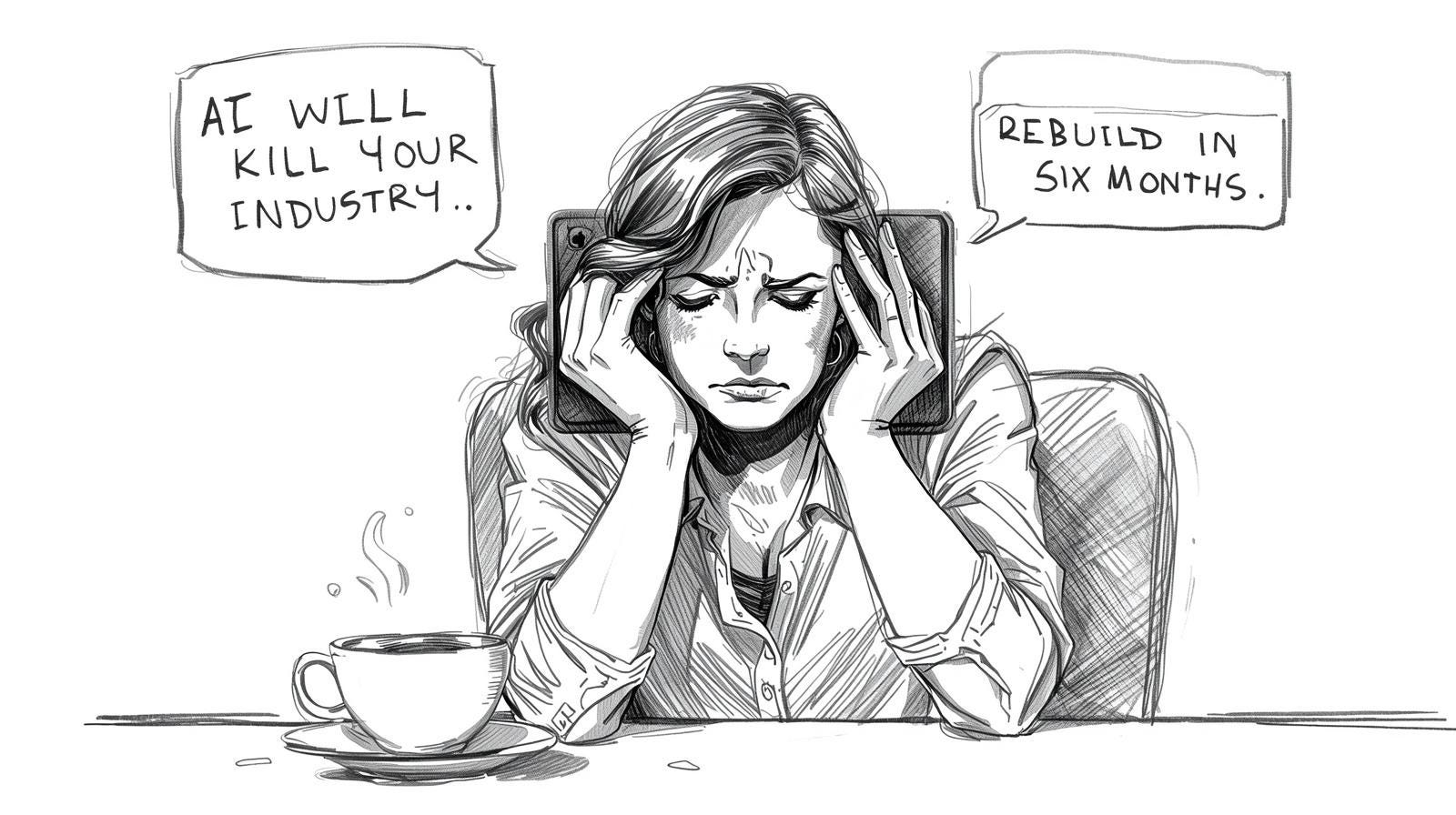
“Everyone keeps telling me I’m doing it wrong,” she said. “This person says AI is going to kill my industry. This person says I need to rebuild my entire business model in six months. This person says the way I’ve been recruiting for fifteen years is obsolete.”
She put the phone down. “I can’t tell if I’m actually behind or if everyone is just selling panic.”
Both, is the honest answer. Some of the change is real. Some jobs are genuinely being reshaped. But the volume of panic being produced far exceeds the volume of actual threat.
There’s a gap between what’s happening and what we’re being told is happening, and that gap is where a lot of people are making money.
Fear drives attention. Attention drives engagement. Engagement drives revenue. Every platform is built around this loop because fear is the cheapest emotion to manufacture and the most reliable to monetise. A 2021 study published in PNAS (Mooijman et al.) found that moral outrage spread significantly faster on Twitter than neutral content, with each moral-emotional word increasing retweet rates by about 20%. Fear behaves the same way.
A calm person doesn’t click. A calm person doesn’t buy a course, doesn’t reshare the post that made them feel inadequate. A calm person just lives. And living doesn’t generate data.
David told me something I wasn’t supposed to repeat
I started cataloguing where the anxiety was coming from. The LinkedIn thought leaders posting daily about “the future of work” are selling coaching programmes. The Substack writers warning your industry will be gone by 2026 are selling paid subscriptions. The YouTube channels predicting mass unemployment are selling courses on how to beat the AI.
None of this is accidental.
One creator I know, I’ll call him David because that’s not his real name, told me something honest over beers several months ago. He runs a popular career advice account, maybe 100,000+- followers, the kind of profile that gets reposted by people who should know better. He told me his best-performing posts are the ones that scare people.
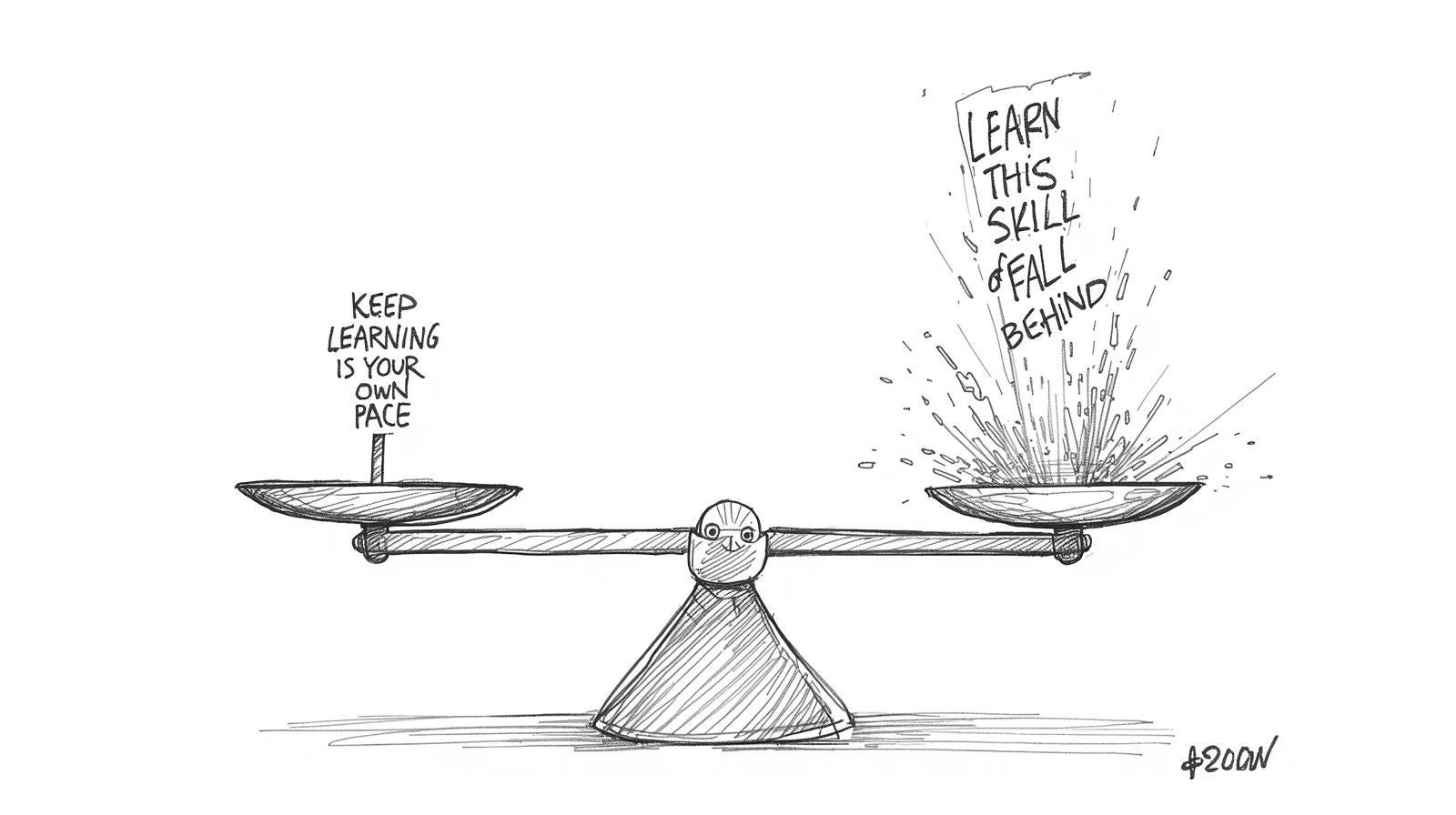
“I tested it,” he said. He was on his third beer and had the specific looseness of someone who’d decided to tell a story he usually kept quiet. “I wrote a post saying everything is fine, just keep learning at your own pace. Got 200 likes. Wrote a post saying if you don’t learn this skill by next month, you’re already behind. Got 12,000 likes and 400 shares.”
I asked him if he believed the scary posts.
He paused. Long enough that I noticed. “I believe them enough to write them. I don’t believe them enough to lose sleep over them.”
The people creating the noise aren’t necessarily more anxious than anyone else. They’ve figured out that anxiety is the most reliable currency they have. David may not be seen as a villain by some, while others do view him that way. But for the majority, he’s just someone operating rationally inside a system that rewards activation over accuracy.
There’s something I keep thinking about from that conversation, though. He mentioned that he’d tried to stop writing the scary posts twice, gone back to “just be calm and keep building” content, and both times watched his engagement fall off enough that it felt like a business decision.
He didn’t frame it as capitulation. He framed it as realism. I’m not sure I can argue with him, exactly, but I also haven’t stopped thinking about it.
Confessions from Inside the Machine
I write about AI and the job market. I’ve written articles with titles like “Your Job Isn’t Disappearing. It’s Shrinking Around You in Real Time.” I’ve written about salary bands becoming obsolete, about the hiring process breaking, about AI agents eating knowledge work.
Those articles are true. I believe what I wrote.
But fear is part of what makes people click, and I’d be lying if I said I didn’t think about that when I write a headline. There’s a tension every time I publish something. Part of me wants to inform and help. Another part knows that the more unsettling the angle, the further it travels.
I could post “You will lose your job in 6 months” and benefit from the same system I’m describing here.
And I know I’m hurting myself, as more people would read it, more people would share it and I can grow faster. But I still write things I actually believe, avoid manufacturing panic where it doesn’t exist, and am honest about uncertainty when I feel it. But honesty doesn’t travel as far as fear does.
It’s no surprise that people write those kinds of headlines. Fear sells.
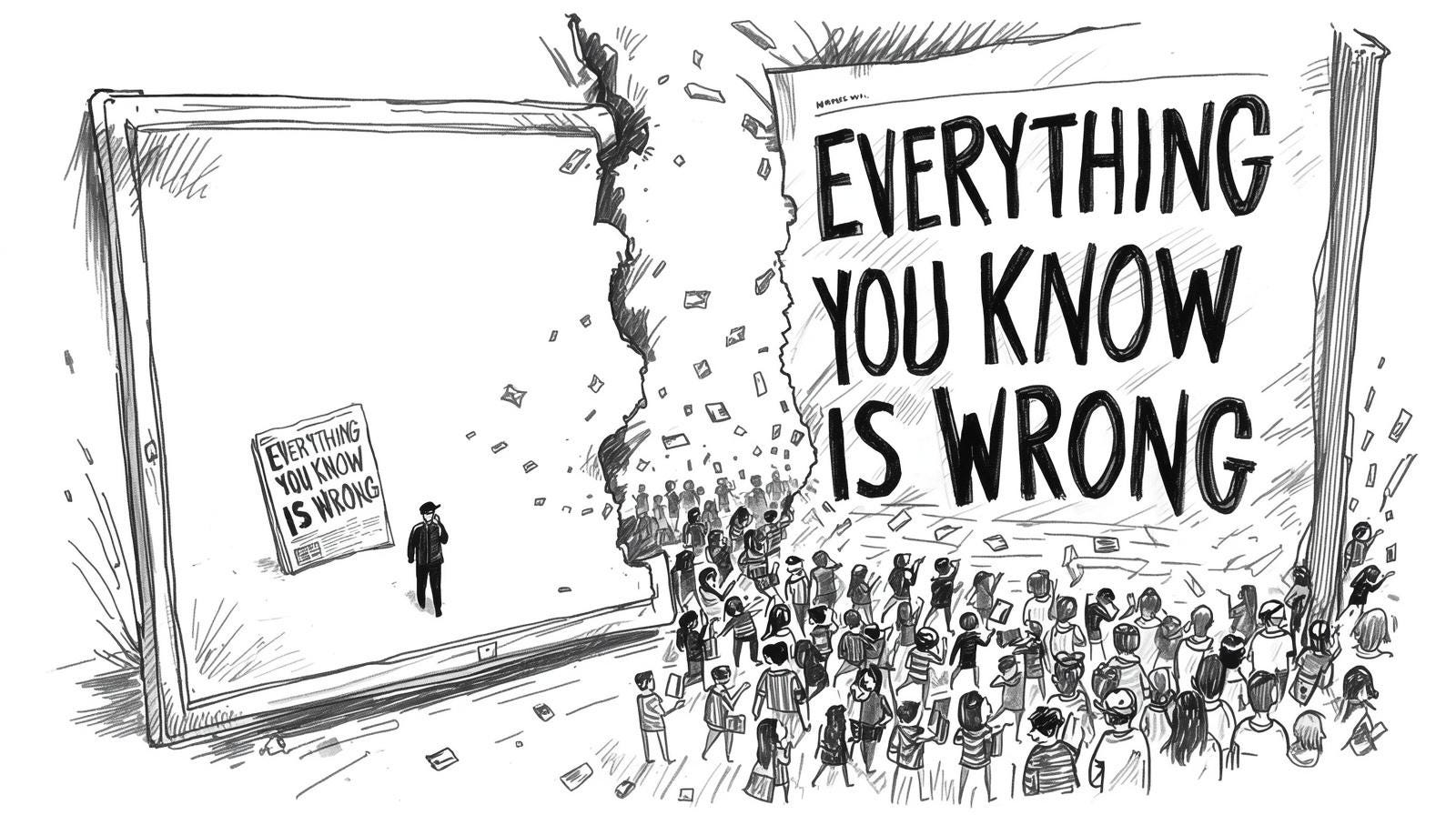
A measured take on AI hiring trends gets 300 reads. “Everything You Know About Job Searching Is Wrong” gets 3,000. I’ve seen the numbers. The temptation is structural, not personal.
Sometimes I wonder… what if I scared people with every single post, just like those spineless folks do? How huge could my accounts get? But we’ll never know.
I have a friend named Markéta who works in HR for a large Czech company. Fifteen years of experience, respected by her team, solid reputation internally. She sends me messages maybe once a week with links to articles. “Is this true?” “Should I be worried?” “Are we doing enough?”
The articles are always variations on the same theme. AI will replace HR. Recruiters will be obsolete. The function is dying. Most of them are written by people who have never worked in HR, making confident predictions about a field they don’t understand, using language designed to maximise shares and minimise nuance.
I tell her the same thing every time: some of it is directionally correct, none of it is as urgent as the headline suggests, the people writing it don’t know her specific situation.
She thanks me. A week later, she sends another one.
Two weeks without the noise
A few months ago I tried an experiment. For two weeks, I consciously avoided any content framed around fear. No “you need to know this or else” headlines. No career anxiety bait. No apocalyptic AI predictions.
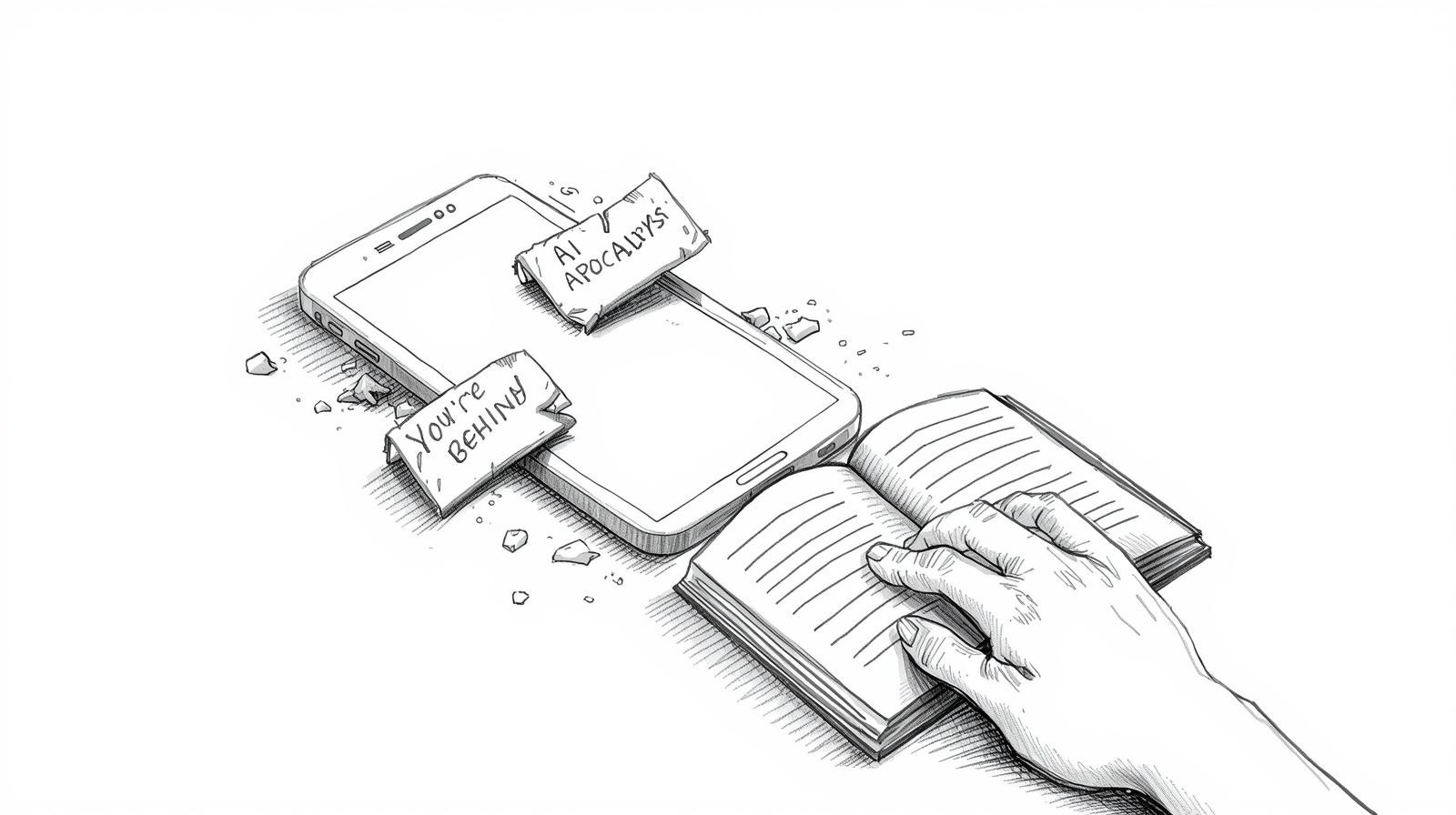
I replaced it with books. Physical books, where nobody was trying to sell me a course in the footnotes.
The first three days felt strange. Quiet in a way that was uncomfortable. I kept reaching for my phone to check what I was supposed to be worried about today. There’s a withdrawal period when you stop consuming anxiety, a low-grade restlessness that I can only describe as the feeling of being late for something you can’t name.
By day five, the urgency faded. Problems I’d thought were existential started looking manageable. Skills I was panicking about not having didn’t seem as critical when I wasn’t being reminded of them hourly.
By day ten, I was bored. Genuinely, flatly bored. And that boredom felt different from the anxiety-boredom. Without a constant low-level fear organising my attention, I had to decide what actually mattered to me, not just what I was supposed to be worried about. It was harder than I expected. I’m not sure I did it well.
I didn’t go back to consuming anxiety content after the experiment ended, but if you are on LinkedIn or online, it’s unavoidable. But I am trying to pay less attention to it and block all those fearmongering people.
The cost isn’t the course
The obvious cost of the anxiety economy is financial. People buy courses they don’t need, subscribe to newsletters that keep them scared, pay for coaching from people who’ve never done the job they’re coaching for. That part is visible and easy to track.
The real cost is slower. It’s the erosion of confidence.
When you’re told constantly that you’re falling behind, you start believing it. When every headline suggests your skills are obsolete, you stop trusting your own competence. The anxiety becomes internalised to the point where reality stops mattering. You can’t distinguish between a genuine threat and a manufactured one because both feel identical in the body.
There’s research that speaks to this more precisely than I can. A series of studies by Sonia Lupien at the University of Montreal showed that chronic low-grade stress, the kind that doesn’t spike dramatically but just persists, measurably impairs memory consolidation and decision-making. Not acute crisis stress. Chronic background noise stress. The kind you get from a feed that whispers inadequacy at you for six hours a day.
The number of capable people who will make bad career decisions not because the market forced them to, but because someone convinced them they were already losing, is something I genuinely don’t know how to calculate. I’ve watched it happen to people I respect. They’re objectively good at their jobs. They have experience, they deliver results. But they talk about their careers like they’re in the middle of a slow emergency. The evidence of their own competence stops registering.
I don’t know if there’s a way to inoculate yourself against this. I’ve tried the experiment. I’m still susceptible. The best I’ve found is a single question: who benefits when I’m afraid right now? If the answer is the person who wrote what I just read, that’s useful information. Not a cure. Just a moment of separation between the thing that activated me and what I actually do next.
Most of the time I still click the headline anyway. But at least I know what’s happening while I do it.
How I Audit a Scary Career Prediction Before Believing It
Here are 4 things I do whenever I come across these types of scary predictions:
