


The skills in AI-exposed jobs are now changing 66% faster than they were just a year earlier. That number comes from PwC’s 2025 global workforce analysis. I read it last weekend and still think about how AI will force us to redefine everything we do. Many companies just finished updating their salary bands a few months ago, and they will all be wrong in the next few months (next year).
Not slightly outdated. Structurally outdated. The band describes a role that no longer requires the same skills, produces the same output, or holds the same value as it did when someone last opened the spreadsheet.
Salary bands get reviewed once a year. Sometimes every 18 months. The review process involves benchmarking against market data, auditing job descriptions, getting sign-off from finance, and publishing an updated range. It takes weeks. Often months. By the time the new numbers are live, the job underneath them has already shifted.
This isn’t a new observation about bureaucracy being slow. Bureaucracy has always been slow. What’s new is that the thing being measured is changing at a pace that makes the measurement instrument useless. A thermometer that updates once a day works fine for weather. It doesn’t work for monitoring a nuclear reactor. And the laws being written right now to enforce pay transparency are anchored to a model of work that is already cracking.
66% Faster Than the Spreadsheet
The premise behind salary bands is straightforward. Define a role. Benchmark it against the market. Set a floor, a midpoint, and a ceiling. Place people within the range based on experience, tenure, and performance. Review periodically. Adjust. The system assumes that a “Senior Data Analyst” this year looks roughly like a “Senior Data Analyst” last year, with maybe one new tool or a slightly updated responsibility.
That assumption held for decades. It doesn’t hold now.
The World Economic Forum’s Future of Jobs Report projects that 39% of existing skill sets will become outdated or substantially transformed between 2025 and 2030. Not over a generation. Over five years. In a single band-review cycle, the role being reviewed may have already lost or changed nearly two-fifths of the skills it was originally priced around.
Think about what that means for the comp team doing the review. They’re opening a job description that says “Proficiency in Excel, SQL, and statistical analysis.” The person in the role is now doing prompt engineering, AI-assisted segmentation, and automated reporting that used to require a junior analyst working two full days. The description and the reality have quietly divorced. The band is pricing a ghost.
And the speed is accelerating, not stabilizing. In 2025, skills in AI-exposed jobs were changing 25% faster than average. Last year it was 66%. Nobody has a model for what next year looks like, because the tool we use to measure these things (annual benchmarking cycles, compensation surveys that take six months to compile and publish) was designed for a world where roles moved slowly.
There’s a question I keep turning over, which is whether collective bargaining frameworks (in some locations and companies) have anything useful to offer here. Union contracts tend to be even more rigid about pay bands than corporate comp structures. Traditional labor agreements specify pay by classification, and those classifications are negotiated years in advance.
If some companies can’t keep up, it’s hard to imagine that a negotiated contract reviewed every three years would do better. But maybe there’s a version of collective action that could respond faster.
The practical consequence is blunt. The salary band is a lagging indicator. It tells you what a role was worth when someone last looked at it. The gap between that snapshot and reality is growing every quarter.
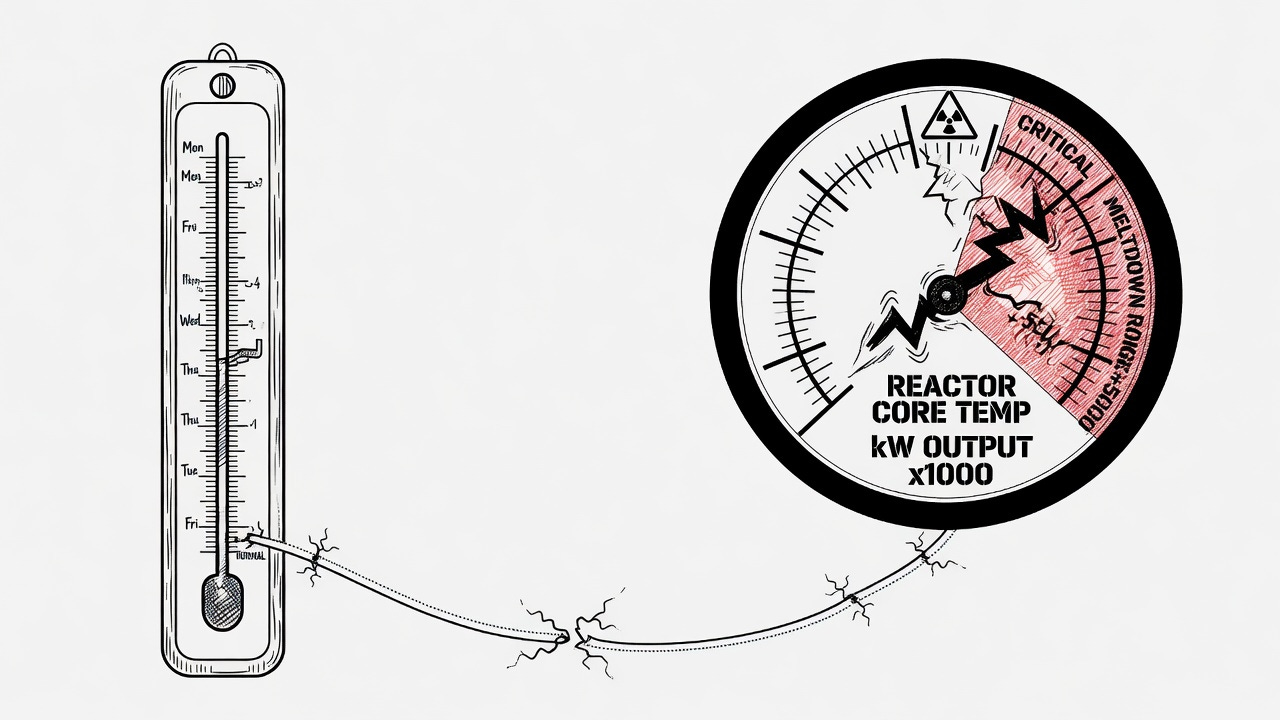
The Job Description Doesn’t Describe the Job
There’s a more philosophical problem underneath the speed issue, which is probably why most comp teams avoid it.
A salary band is attached to a job description. The description defines the role. The band prices the role. Simple chain. But the chain breaks when the description and the actual work diverge far enough.
If 39% of the skills in a role get replaced or augmented over five years, at what point is it a different role? Not a slightly updated version. A fundamentally different job wearing the same title. A “Content Strategist” writing blog posts by hand in 2023 and a “Content Strategist” managing AI content pipelines, editing model outputs, and building prompt libraries in 2026 share a title. They do not share a job.
The band treats them as interchangeable.
A comp consultant from Spain whom I spoke with last spring (she was running late to the call because her dog had escaped into a neighbor’s yard, which she mentioned twice, apologetically, before we actually started talking) described a calibration meeting at a client company where a manager argued that one of her reports had effectively reinvented the scope of her position. The employee was producing roughly twice the output of peers, had absorbed analytical work previously sent to an outside vendor, and had built internal tools that three other departments were using. The manager wanted to move her up a level.
She told me that the HR/TR team blocked it. The job description for the next level required management responsibilities. The system had no mechanism for someone who’d expanded a role horizontally rather than vertically. The band structure could process seniority. It couldn’t process transformation.
I should note that the employee’s situation was unusual. She had a technical background, most people in her title didn’t, and she’d been experimenting with AI tools for a year before the company formally adopted anything. Most people in the same role hadn’t made comparable changes. But the system’s inability to recognize what she’d done, its inability to even categorize it, felt like a symptom of something larger.
The job description is becoming administrative fiction. Useful for legal compliance and organizational charts. Disconnected from the actual work. And when your pay structure is anchored to a fiction, the pay stops reflecting reality. It starts reflecting the last time someone updated a document.
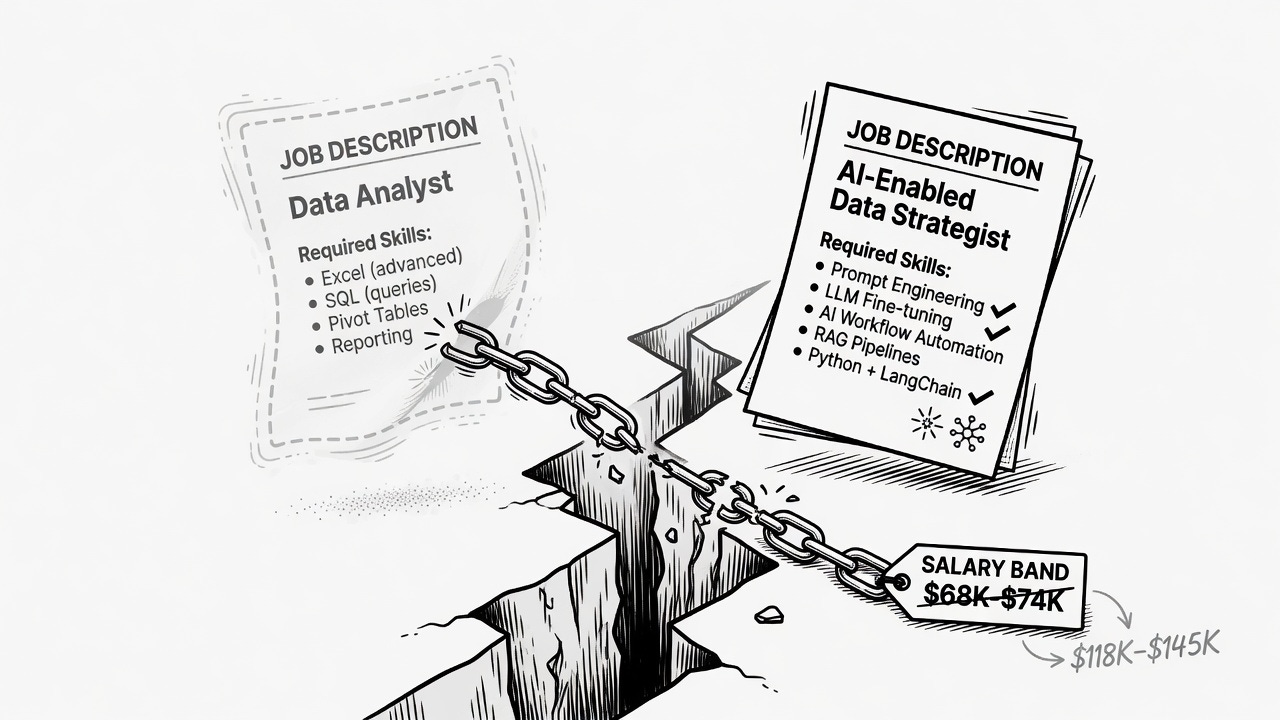
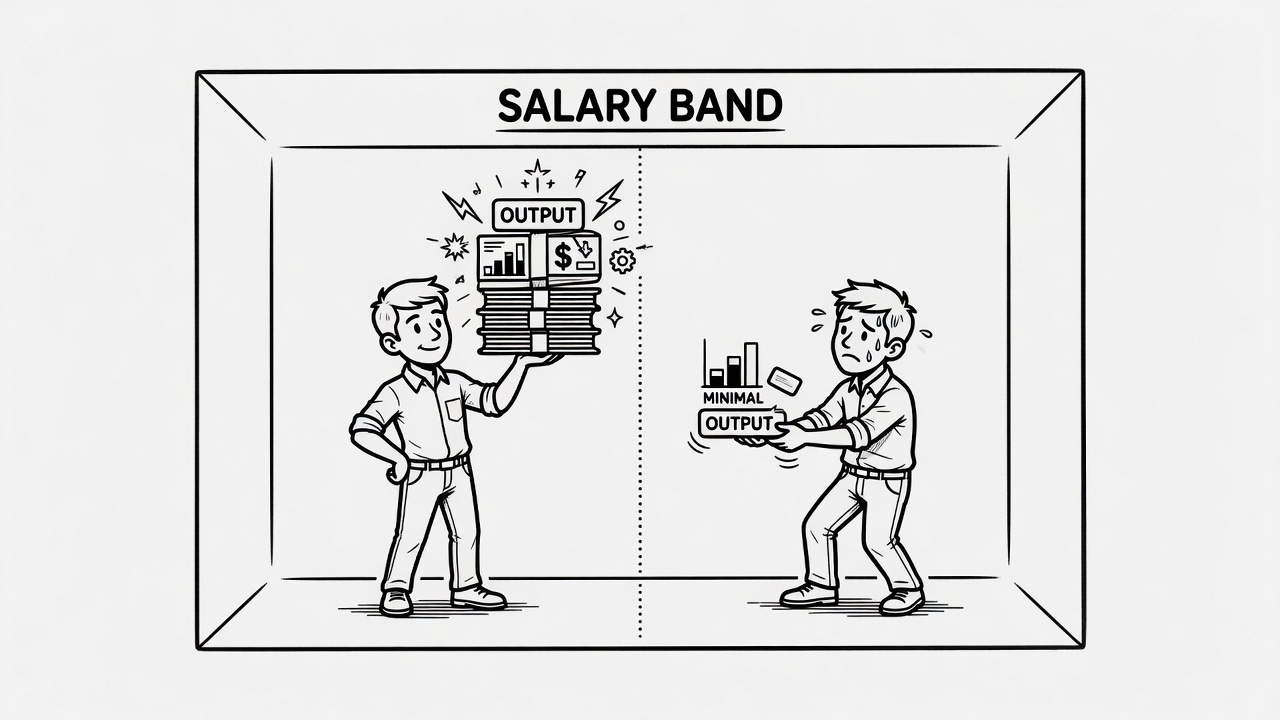
Same Band, Wildly Different Value
This is where the structural problem becomes personal.
Picture someone who spent evenings and weekends learning AI tools. Not because their company mandated it. Not because there was a training program. Because they saw where things were headed and invested their own time. They got faster. They got better. They started producing work that would’ve required two people a year ago. Their manager noticed. Peers started asking them for help.
Their salary didn’t change.
They’re still sitting inside the same range as someone who does the job the old way, takes twice as long, and produces half the output. The band was designed for fairness. People in the same role should be paid within the same range to prevent discrimination and favoritism. That was a good idea. In most ways it still is.
But “the same role” doesn’t mean what it used to.
A 2023 study from researchers at MIT and Stanford tracked customer service agents using an AI assistant. Average productivity rose 14%, with the largest gains among the least experienced workers. That’s the average. The spread within the group was enormous. Some agents barely changed their workflow. Others transformed it.
When the variation in output within a single title gets wide enough, the band stops creating fairness. It starts creating resentment. The high performer looks at the range ceiling and sees a cap that has nothing to do with their contribution. The low performer looks at the floor and sees protection. Both are right from where they’re standing, which is exactly the problem.
The pattern that follows is predictable. The person who adapted, who invested, who made themselves dramatically more valuable, doesn’t get loud about it. They get quiet. They start asking careful questions about internal mobility. They update their LinkedIn profile on a Sunday afternoon. They’re gone within a year, and the company acts blindsided.
There’s a cost to fixing this too, and I want to be direct about it. If you break the band to pay your AI-skilled performer more, you’ve told everyone else in the same title that the range is negotiable, that some people’s contributions count for more than others, and that the system they were told was fair actually isn’t. That’s a real organizational cost, not a hypothetical one. I genuinely don’t know how you manage that tradeoff well. Every approach I’ve seen, read, or heard about so far creates a new problem while solving the old one.
And this conversation assumes every role is actually growing. Not all of them are. Some positions aren't being transformed by AI. They're being quietly hollowed out. The work is shrinking, the scope is narrowing, and the role is drifting toward something a well-configured automation could handle by next quarter. Nobody sends a memo about it.
The job title stays on the org chart, the band stays in the spreadsheet, and the person in the seat keeps collecting the same paycheck for a role that the company no longer needs in the same way, or at all. These aren't people who failed to adapt. They're people whose roles simply stopped offering anything for AI to augment. There's no upskilling path for a job that's evaporating. And the band, predictably, says nothing about that either.
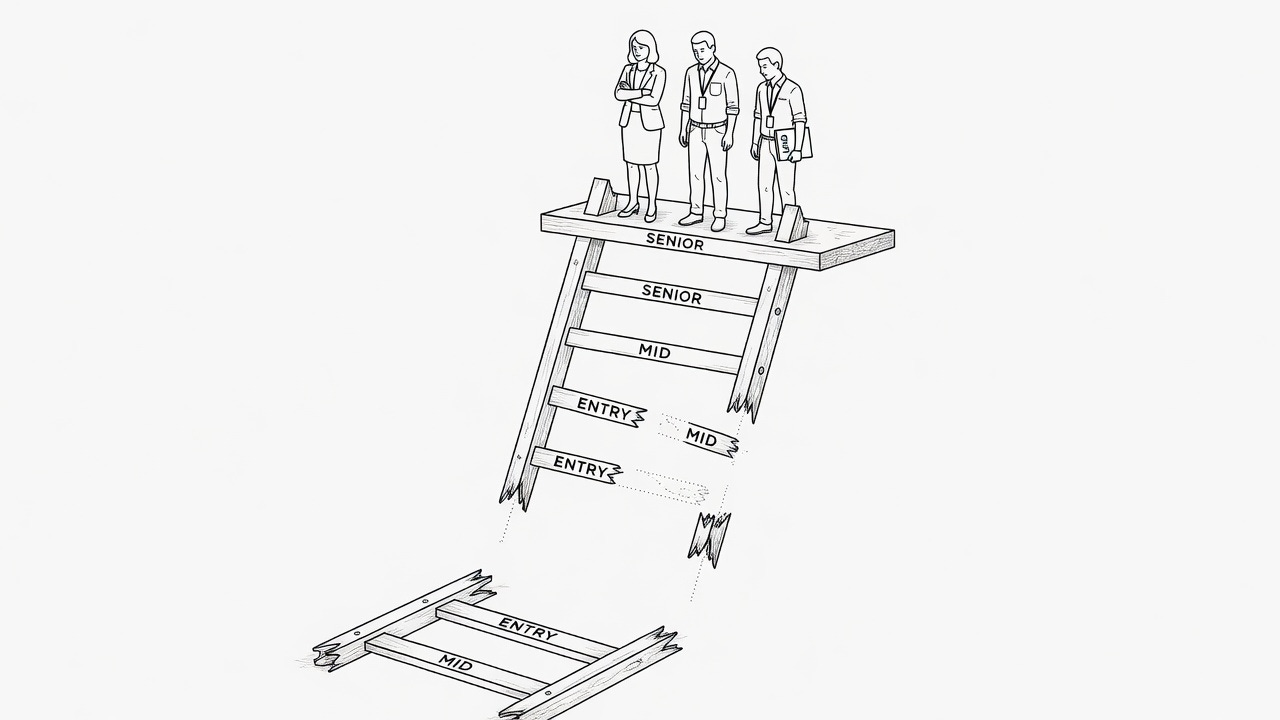
Pull Out the Bottom Rungs and Call It a Ladder
Everything I’ve described so far affects people already inside the system. But there’s a structural issue underneath that I think will matter more over time.
Entry-level hiring in many industries dropped. Half of reward leaders surveyed by Ravio, a compensation data platform, explicitly cited AI automation as the reason for deprioritizing junior roles.
Salary bands are built as ladders and comp teams. Entry, mid, senior, lead, principal. You start at the bottom, you climb. Each rung has a range. The ranges overlap slightly to create a progression path. The architecture assumes a population at every level, with people entering at the bottom and moving up.
What happens to the architecture when the bottom levels empty out?
Five years ago, an entry-level data analyst posting listed SQL, Excel, maybe some basic Python, and “strong communication skills.” Now postings for the same nominal level want experience with AI-assisted analysis, prompt engineering, and “the ability to evaluate and improve model outputs.”
These are skills that used to live at the mid-level. They’ve been pushed down into entry-level descriptions. But the entry-level band hasn’t moved up to match. And in many companies, the posting exists on paper but nobody’s actually filling it.
You can’t have a progression-based pay architecture when there’s nothing to progress from. A company with six levels and nobody in the first two isn’t running a ladder. It’s running a shelf. People arrive mid-career or they don’t arrive at all, and the comp structure below them is vestigial, a set of ranges for people who don’t exist.
I’m not sure what this means for compensation design long-term. The obvious move is restructuring bands to reflect a workforce that enters at a higher skill floor and has a shorter distance to the ceiling. But I haven’t seen anyone do that well yet. Most companies I’ve heard about are still running the old structure and just leaving the bottom levels empty. The architecture assumes a population that doesn’t show up anymore.
Transparency Was Supposed to Fix This
Pay transparency laws are spreading. Colorado, New York City, Washington State, California, Illinois, whole Europe. The direction is toward more disclosure, more posted ranges, and more visibility. The reasoning is sound: if everyone can see the range, companies can’t quietly underpay people based on gender, race, or negotiation skill. That’s a real problem, and transparency is a reasonable response.
But transparency assumes the range means something stable. It assumes that “$XK to $YK for Software Engineer” describes a coherent group of people doing roughly comparable work.
Two people inside that range might be delivering wildly different value. One writes code the traditional way. The other uses AI tools to do what two engineers used to do, has automated half the team’s deployment process, and spends freed-up hours on architecture decisions that used to belong to someone a level above. The range says they’re equivalent. Their output says they’re not.
A Head of People at a Slovakian startup told me something that has been rattling around in my head since I heard it. She said: “We posted our ranges because the law requires it. But internally, the ranges create more problems than they solve. Our strongest people see the ceiling and get demoralized. Our weakest people see the floor and feel safe. And I can’t explain to either group why the system works the way it does, because it was built for a different kind of workforce.”
She’d been considering output-based bonuses as a workaround. Pay the base inside the band, then layer variable comp on top tied to measurable results. I’ve heard this from a handful of other companies too. It sounds reasonable until you try to define “output” for most knowledge work.
What counts as output for an HR business partner? For a program manager? For legal counsel? Sales has quota. Engineering can maybe count shipped features, though even that’s debatable. Most roles don’t have a clean metric, and defining one poorly (which is what happens when you rush) creates perverse incentives that are worse than the original problem.
I don’t have a prediction for how this resolves. The current system is fracturing. Transparency requirements are making the cracks visible to everyone, which was the point, but the cracks are in the structure itself, not just in how it was being applied.
Something will replace this, or at least significantly modify it. But the replacement hasn’t arrived yet, and I’m skeptical of anyone who claims to have it figured out. Most of what I’ve heard about so far is the old model with a new label.
The question that keeps coming back is whether fair pay can even exist when the same title, in the same company, on the same team, now describes two fundamentally different jobs. I don’t think anyone has answered that yet. I’m not sure anyone has fully asked it.
The salary band was never meant to be eternal, but it was built for a world where human capability evolved on human timescales. In the age of AI, the real compensation challenge is no longer how to price a job; it is how to reward the rare combination of judgment, taste, and rapid adaptation that turns a tool into leverage, before the next wave of augmentation renders even that edge temporary.
In case you missed it:


