


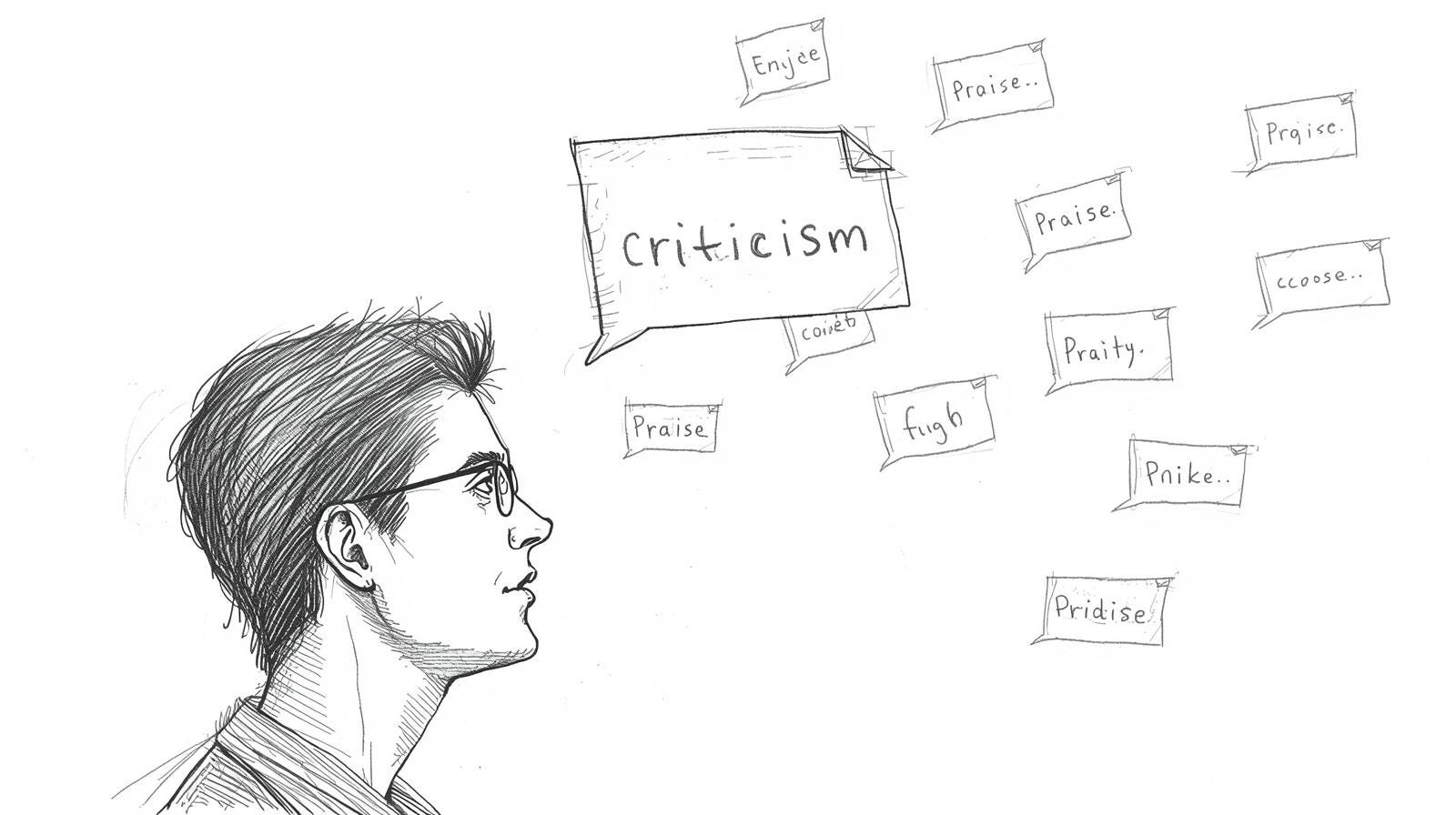
You get your annual performance review. Ten pieces of positive feedback and one area for improvement. Three days later, the only thing you will remember is the criticism. The praise? Gone, not entirely, but it immediately lost its value when you hear what you need to improve. You can reconstruct it if you try, but it doesn’t stick the way the negative comment does. That one lands in a different part of your brain entirely.
This isn’t a personality flaw. It’s negativity bias, and it’s universal enough that researchers have tracked it across cultures, age groups, locations and contexts. A 2001 study by Baumeister and colleagues analyzed hundreds of psychology experiments and found that bad events produce more emotion, more persistent thoughts, and stronger impacts on behavior than neutral or good events of similar magnitude.
The ratio isn’t subtle. In relationship research, it takes roughly five positive interactions to balance one negative interaction. In memory studies, people recall negative images more vividly than positive ones even weeks later.
Your brain evolved this way for a reason. Ten thousand years ago, missing a piece of good news (ripe fruit in a distant tree) cost you a meal. Missing bad news (predator in the brush) costs you your life.
Natural selection didn’t optimize for happiness, and it didn’t care about your comfort. It optimized for not dying. The humans who survived long enough to become your ancestors were the ones whose brains treated every ambiguous shadow as a potential threat.
The problem is that the environment changed faster than the wiring. You’re not scanning for predators anymore, at least not for those that can eat you, unless you are living somewhere in the wilderness. So you’re scrolling X, Insta, TikTok, reading performance reviews, checking your bank balance.
But your threat detection system hasn’t updated its assessment. It still treats social criticism like physical danger, uncertainty like imminent attack, and any negative information as something that requires immediate, sustained attention.
The world got safer, but your brain didn’t get the memo. And now that mismatch is running in the background of every interaction you have.
Nine compliments vanish, one criticism sticks
When your brain gets nine positive comments and one negative one. The positive comments get processed through your brain’s reward system, which is designed to notice good things and then move on. Dopamine spikes briefly, and you feel pleased. Then the system resets because, in evolutionary terms, contentment is dangerous. If you’re satisfied, you stop looking for threats.
The negative comment goes somewhere else entirely. It hits your amygdala, a small, almond-shaped structure within the brain’s temporal lobe, which doesn’t reset. The amygdala’s job is threat detection, and it has a much longer memory than your reward system. It’s also louder. A 2003 study (A PET Activation Study) using fMRI scans found that negative images produced significantly more activation in the amygdala than positive or neutral images, and that activation lasted longer.
You can see this in hiring, too. Managers routinely overweigh negative information about candidates. One mediocre reference outweighs three strong ones. One gap in a resume gets more attention than five years of solid performance. I still remember a case in 2010 where hiring committees spent 40 minutes discussing a candidate’s single weakness and five minutes on their strengths, then claimed they gave both “equal consideration.”
You can see this in relationships, too. Partners routinely overweigh negative interactions. One cold response after dinner outweighs three weeks of warmth and effort. One forgotten anniversary gets more attention than five years of showing up consistently.
The bias compounds when you’re making decisions under uncertainty. If you don’t have complete information, your brain fills in the gaps with threat assumptions. Silence from your boss becomes evidence of disapproval. A colleague’s distraction becomes a signal they’re upset with you. An ambiguous email gets read in the most negative plausible tone. This is exactly how our brain works.
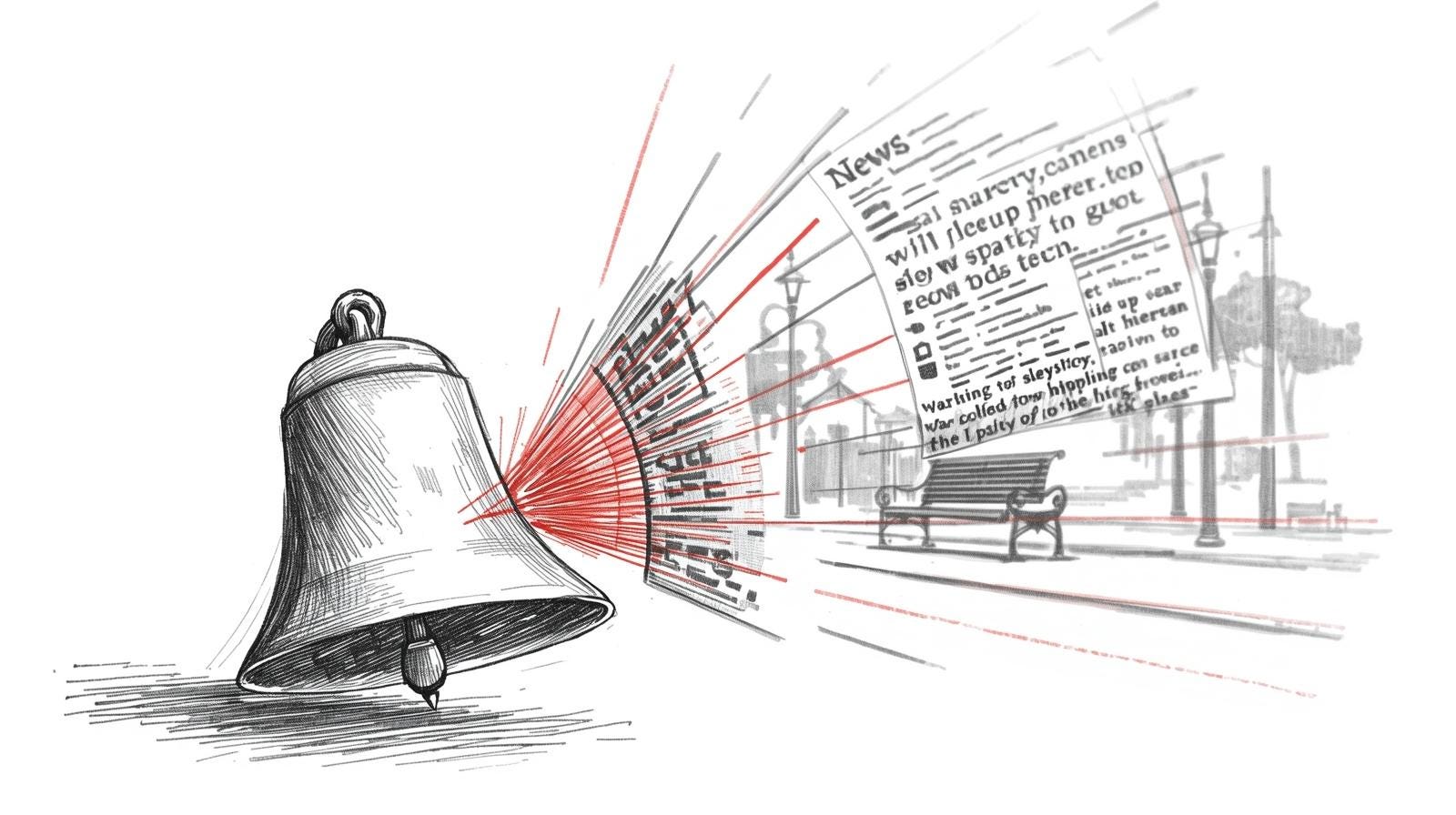
And the pattern accelerates in environments designed to exploit it. Social media platforms don’t show you a representative sample of human behavior. They show you whatever generates engagement, and negative content generates more engagement than positive content. Outrage spreads faster than joy.
A 2018 MIT study “The spread of true and false news online” tracked 126,000 news stories on Twitter (now X) and found that false news reached 1,500 people six times faster than true stories, largely because false news tended to be more negative and more novel.
Your feed isn’t a window into reality; it’s sadly a window into what your amygdala can’t ignore.
Gratitude journals, forced smiles, and strategic avoidance
The standard advice for dealing with negativity bias falls into three categories, and all three make the problem worse if you follow them literally.
Fix one: Ignore negative information.
The logic here is that if your brain overweights bad news, you should consciously underweight it. Treat criticism as noise and focus on the positive. This works until you encounter negative information that actually matters. Your bank account is overdrawn, your project is behind schedule, or a relationship is deteriorating. Ignoring real problems because you’ve trained yourself to dismiss negative signals is how small issues become catastrophic ones. We’ve all been there, ignored a small issue that spiraled into a total disaster, we still think about years later.
I learned this when I got my first car, a Hyundai Getz. I really loved that car back then, even though my friends teased me about the brand. And I stayed loyal to this brand over the years.
One day, the “check engine” light came on, but the car seemed fine. I told myself it was probably just a faulty sensor. I chose to ignore the warning and focused on how well it was running. A few weeks later, I was stranded on the side of the highway with an overheated engine. A simple fix had turned into a major, expensive repair. That day taught me that while staying positive is good, ignoring clear warning signs can lead to much bigger problems. Some problems will never go away, no matter how positive your mindset is.
Another thing I learned back then was that I really need to know more about the cars I’m driving.
Fix two: Force positivity.
Gratitude journals, affirmations, and deliberate reframing of every setback as a learning opportunity. The research on this is mixed at best. Some studies show benefits from gratitude practices, but they tend to be small and they fade. A 2023 meta-analysis found that gratitude interventions produced effect sizes around 0.22 for positive well-being, meaningful but not transformative. The effects tend to be larger in populations that were initially depressed, smaller in healthy populations trying to boost baseline happiness.
More importantly, forced positivity creates a secondary problem. If you’re trying to feel grateful and you don’t, you now have two problems: the original negative event and your failure to properly appreciate your circumstances. At the end, you feel bad about feeling bad.
Fix three: Numb out.
Reduce exposure to negative information entirely. Quit social media, stop watching the news. Ideally, avoid any difficult conversations you might have. This works in the short term. Your ambient anxiety drops.
But you’re not fixing the threat detection system, you’re just removing the triggers. And the system doesn’t get less sensitive when you remove stimuli. It gets more sensitive, sometimes way more sensitive. The longer you avoid something, the larger it looms. When you finally encounter negative information again, your response is bigger than it would have been if you’d maintained exposure.
I’m not saying these strategies never work. Gratitude practices can be helpful for some people, and there were times in my life when I’d say they worked for me. Reducing doomscrolling is probably net positive for most. I can tell you from experience, it really worked for me. When I took a break from Facebook and Insta, my anxiety went down, and my mood and focus got a lot better.
But they’re treating the symptoms, not the mechanism. Your brain is doing exactly what it evolved to do: prioritize threats. The question isn’t how to convince your brain to stop. The question is how to give it a task that actually helps.

Your amygdala still thinks you live in 8000 BCE
The mismatch between ancient wiring and modern environment shows up most clearly in what psychologists call “probability neglect.” Your brain is not good at calibrating risk. It treats low-probability, high-severity events (plane crashes, terrorism) as more dangerous than high-probability, low-severity events (car accidents, poor diet). It overweights vivid, recent threats and underweights abstract, distant ones.
This made sense in the ancestral environment. If you saw a lion once, you needed to remember it forever. The base rate didn’t matter; you didn’t need to know that lions only attacked humans in 0.01% of encounters. You needed to know that lions are dangerous and to avoid them. A simple survival instinct.
But in a world where most threats are probabilistic rather than binary, this creates systematic errors. You worry more about stranger danger than car accidents, even though your kid is vastly more likely to die in a vehicle. You worry about terrorism more than heart disease. You treat market volatility as more dangerous than sustained low returns.
And because modern media is optimized for engagement, not accuracy, you’re constantly being fed the vivid, recent, high-salience threats. The algorithm doesn’t show you “nothing happened today in 99.9% of places.” It shows you the plane crash, the mass shooting, and the financial collapse. Your amygdala catalogs each one as evidence that the world is getting more dangerous, even when aggregate statistics show the opposite.
There’s a version of this that applies to personal threats, too. You remember the person who criticized you more vividly than the ten people who didn’t. You remember the job you didn’t get more than the ones you did. You remember the relationship that ended badly more than the quiet years when things were fine.
Your brain is building a threat model from exceptions, not base rates. And then using that model to guide your behavior.
The feedback loop that creates what it fears
Negativity bias doesn’t just make bad things feel worse. It creates feedback loops that generate more bad things to feel bad about.
You get critical feedback at work, and your brain flags this immediately as a threat. Threat responses narrow your focus. You start monitoring your boss’s behavior more closely. Looking for signs of disapproval. And of course you find them, because confirmation bias kicks in once you’ve decided what you’re looking for. Your increased vigilance makes you more anxious. The anxiety affects your performance. Your performance drops, you get more critical feedback. The loop tightens.
Or, you see negative news about the economy. Your brain catalogs this as a threat to your financial security. You start checking your portfolio more often. Frequent checking exposes you to more volatility, which increases anxiety. Anxiety makes you more likely to sell during a downturn. Selling during a downturn locks in losses. Losses confirm the original threat assessment. You check more often.
The pattern shows up in relationships too. You interpret your partner’s distraction as evidence they’re upset with you. You withdraw or become defensive. They notice the shift in your behavior and actually become upset. Your original interpretation is now validated, but only because you acted on it first.
I’m not convinced this pattern is universal. There are people who seem less prone to these spirals, and I can’t tell if that’s because their baseline negativity bias is lower, because they’ve developed better circuit breakers, because their DNA is different, or because they’re in environments that don’t activate the bias as strongly. Maybe they were influenced by their parents or grandparents, but that’s just a guess. But in the cases where the loop does form, it’s self-reinforcing.
And the modern environment is full of systems designed to activate it. Performance management systems that focus on gaps rather than strengths.
Social media platforms that surface conflict and anything that creates emotion. News cycles that prioritize threats, financial systems that encourage constant monitoring. Each one is tugging on the same evolutionary wire.

Building a counterweight, not fighting the bias
The fix that actually works isn’t about reducing negative input or increasing positive input. It’s about building a deliberate counterweight to the bias that’s already running.
Your brain automatically amplifies negative information. You can’t stop that, but you can build a parallel process that deliberately amplifies positive information in a way that doesn’t feel forced or fake.
This is different from gratitude journaling. Gratitude journaling asks you to notice good things. That’s fine, but noticing isn’t the same as amplifying. Your brain already noticed the good things. It just didn’t file them in long-term storage because they weren’t threats.
What works is building rituals that force elaboration on positive events. Elaboration is what creates strong memories. When something good happens, your brain’s default is to notice it briefly and move on. The intervention is to interrupt that process and make yourself elaborate: What specifically happened? What did it feel like? What does it suggest about the person who did it? What might it predict about future interactions?
There’s research on this from 2006 by Sheldon and Lyubomirsky. They tracked people doing various positive psychology interventions and found that the interventions only worked when people varied the timing and elaborated on the details. Rote repetition of “I’m grateful for X” showed no sustained effect. Detailed elaboration on why X mattered and what it meant showed modest but persistent effects.
The mechanism matters. When you elaborate on a positive event, you’re not lying to yourself or forcing optimism. You’re correcting for a known bias in your storage system. Your brain stored the negative event automatically with high detail and high salience. You’re manually doing the same thing for the positive event.
In practice, this looks like this: Someone compliments your work → Default response: brief pleasure, then move on. → Intervention: Stop. What specifically did they compliment? What effort did you put in that they might have noticed? What does their noticing suggest about how they view your work more broadly? Spend 60 seconds on this.
Or, a project goes well. → Default response: relief, satisfaction, move to next project. → Intervention: What specifically went well? Which decisions contributed to the outcome? What does this suggest about your capability in this domain? Store it with the same detail you’d use if you were analyzing a failure.
This isn’t about self-esteem. It’s about building an accurate threat model. If your brain only stores failures in high detail and successes in low detail, your model of your own capability is wrong. You’ll systematically underestimate what you can handle and overestimate the risks you face.
The intervention works because it matches the way your brain actually operates. You’re not fighting negativity bias. You’re building an equal and opposite process that runs in parallel.
Does it eliminate anxiety? No. Should it? I’m not sure. Some level of threat vigilance is probably adaptive. The goal isn’t to feel good all the time, the goal is to have a threat model that reflects reality instead of evolutionary history.
And let's face it, that is quite hard to do because our brain still thinks that we are chased by predators, so it’s just trying to help us survive.
When the amplification ritual becomes the problem
There are four patterns I’ve seen repeatedly where the standard advice breaks down, and what that suggests about when you should and shouldn’t try to correct for bias.
Most of the advice I’ve heard over the years on managing negativity bias treats it as a universal problem with a universal solution.
But there are situations where your threat detection system is giving you accurate information, and trying to amplify positive signals just adds noise:
